BAS 105867
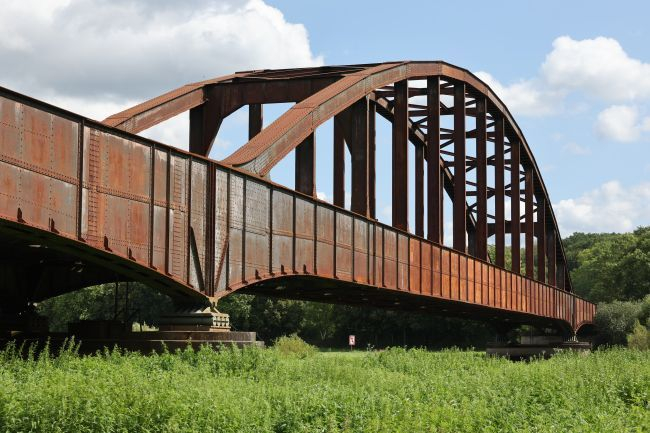
Corvey railway bridge
26.08.2023
© www.brueckenweb.de / Frank Sellke
 Use in accordance with the terms and conditions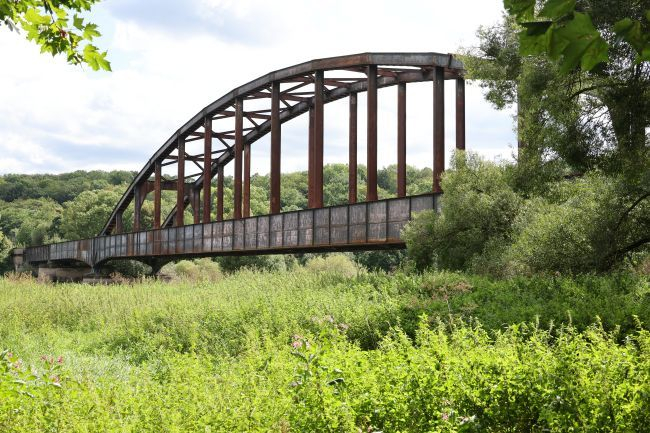
26.08.2023
© www.brueckenweb.de / Frank Sellke
Use in accordance with the terms and conditions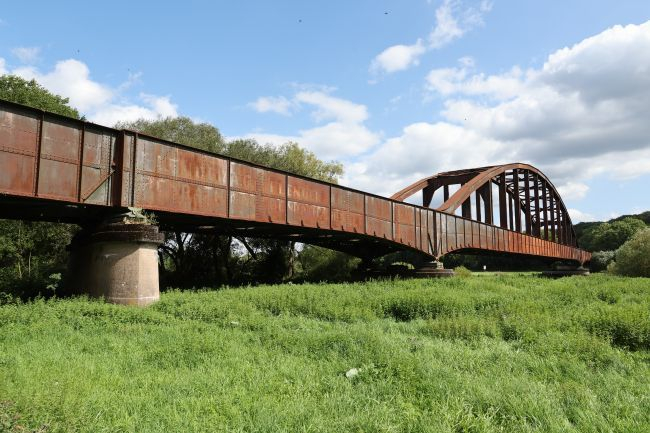
26.08.2023
© www.brueckenweb.de / Frank Sellke
Use in accordance with the terms and conditionsGermany
North Rhine-Westphalia
Höxter
Weser
railroad
Arch bridge, arch over the roadway, tied-arch bridge
steel
1865, Neubau 1929
119.60 m
238.00 m
0.00 m
0.00 m
0.00 m
0.00 m2
in operation
The wrought-iron superstructure, consisting of four bridge spans, was designed by civil engineer Johann Wilhelm Schwedler as a truss girder with a parabolically curved top chord and constructed by the company Jacobi, Haniel & Huyssen, also known as Gutehoffnungshütte, in Sterkrade near Oberhausen.[1] The Weser Bridge was completed in June 1865 after approximately two years of construction.
Wikipedia:
On October 1, 1864, the railway line from Altenbeken to Höxter was opened. This provided a connection to Kassel and further to Frankfurt and southern Germany, via Soest-Münster to Emden, and via Cologne to Belgium and France. Höxter was thus integrated into the already well-developed railway network, to which the Ottbergen railway junction also contributed.
In 1929, a steel replacement structure for two tracks with five spans was put into operation. Continuous, solid-web stiffening girders are located on both sides. Above the main span of 119.6 meters, tied arches are arranged on both sides. The two end spans each have a span of 26.0 meters, and the two inner spans each have a span of 33.4 meters.[2] The bridge was built by Flender A.-G. for iron, bridge, and ship construction from Düsseldorf-Benrath. Before the end of the Second World War, the bridge, like the Höxter town bridge, was blown up by German troops on April 7, 1945, during their retreat from the advancing American soldiers. Reconstruction took place between 1952 and 1954, but initially only with one track.
On October 1, 1864, the railway line from Altenbeken to Höxter was opened. This provided a connection to Kassel and further to Frankfurt and southern Germany, via Soest-Münster to Emden, and via Cologne to Belgium and France. Höxter was thus integrated into the already well-developed railway network, to which the Ottbergen railway junction also contributed.
In 1929, a steel replacement structure for two tracks with five spans was put into operation. Continuous, solid-web stiffening girders are located on both sides. Above the main span of 119.6 meters, tied arches are arranged on both sides. The two end spans each have a span of 26.0 meters, and the two inner spans each have a span of 33.4 meters.[2] The bridge was built by Flender A.-G. for iron, bridge, and ship construction from Düsseldorf-Benrath. Before the end of the Second World War, the bridge, like the Höxter town bridge, was blown up by German troops on April 7, 1945, during their retreat from the advancing American soldiers. Reconstruction took place between 1952 and 1954, but initially only with one track.
A map is loading