BAS 110135
Beolgyo Honggyo (Rainbow Bridge) 보성 벌교 홍교
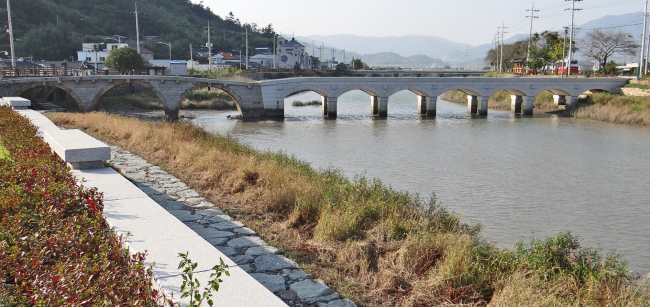
26.10.2013
© Steve46814 (Wikipedia)
 Creative Commons
Keine weiteren Bilder verfügbar
South Korea
Jeollanam-do (전라남도)
Beolgyo
Flow
pedestrian
Arch bridge, arch under the roadway
Stone
1792
0.00 m
0.00 m
0.00 m
0.00 m
0.00 m
0.00 m2
in operation
Boseong Beolgyo Honggyo (寶城 筏橋 虹橋) is a Joseon Dynasty arched bridge located in Beolgyo-eup, Boseong-gun, Jeollanam-do, South Korea. It was declared Korean National Treasure No. 304 on January 21, 1963.
Boseong Beolgyo Honggyo (寶城 筏橋 虹橋) is a Joseon Dynasty arched bridge located in Beolgyo-eup, Boseong-gun, Jeollanam-do, South Korea. The Honggyo Bridge is a stone rainbow bridge spanning the Beolgyocheon stream. It has a total length of 27 meters, a height of approximately 3 meters, and a width of approximately 4.5 meters.
It is said that this bridge was built in the 5th year of King Yeongjo's reign (1729) during the Joseon Dynasty by two monks, Choan and Seopseong, of the Seonamsa Temple in Suncheon. In Buddhism, the meritorious act of the Wolcheon (monk) to build bridges so that people can travel comfortably is considered an important act of charity.
This Hongyo Bridge was repaired in the 13th year of King Yeongjo's reign (1737) and again in the 10th year of King Heonjong's reign (1844). Its current appearance was restored to its original state after four years of repairs from 1981 to 1984.
It is the largest and most impressive stone bridge among the remaining Hongyo Bridges in Korea. It is said that before the construction of Hongyo, a raft bridge was built to cross it, hence the name Beolgyo.
Its current appearance was restored after four years of repairs from 1981 to 1984. Outline
Honggyo refers to a bridge constructed in such a way that its underside forms a semicircle like a rainbow. It is also called an arched bridge, hongyegyo, or rainbow bridge. This bridge is the largest of the remaining hong bridges and is still used by local residents.
Previously, a bridge spanning rivers stood on this site, giving rise to the name Beolgyo. It is said that a monk at Seonamsa Temple built a stone bridge here in the 5th year of the reign of King Yeongjo of the Joseon Dynasty (1729). The bridge was subsequently repaired in the 13th year of King Yeongjo's reign (1737), transforming it into a rainbow bridge with three channels. After four years of repairs from 1981 to 1984, it is what it is today.
In the center of the rainbow-shaped canopy beneath the bridge, a downward-facing stone with a carved dragon's head protrudes. This appears to be an expression of folk religion stemming from the relationship between water and dragons. It is said that wind chimes were once attached to the tip of this dragon's nose to produce the gentle sound of bells. Seawater flows into and out of the river over which the bridge is built. At low tide, most of the bridge deck is exposed, and at high tide, most of it is submerged.
The bridge's original dimensions appear to have been 4 meters wide and 80 meters long, and it is said that the locals hold a 60th birthday celebration for it every 60 years. It is a magnificent structure that, despite its splendid and gigantic appearance, exudes elegance and displays not only excellent engineering but also a sense of grandeur.
Reference material
Karte wird geladen …