BAS 11907
Narrow fields au bridge
01.08.2021
© www.brueckenweb.de / Frank Sellke
 Use in accordance with the terms and conditions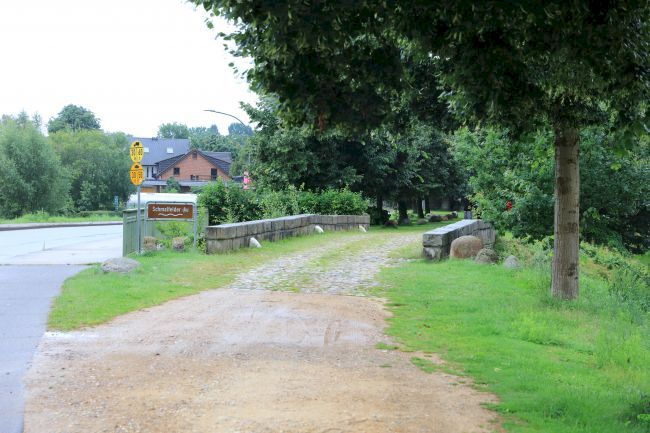
01.08.2021
© www.brueckenweb.de / Frank Sellke
Use in accordance with the terms and conditions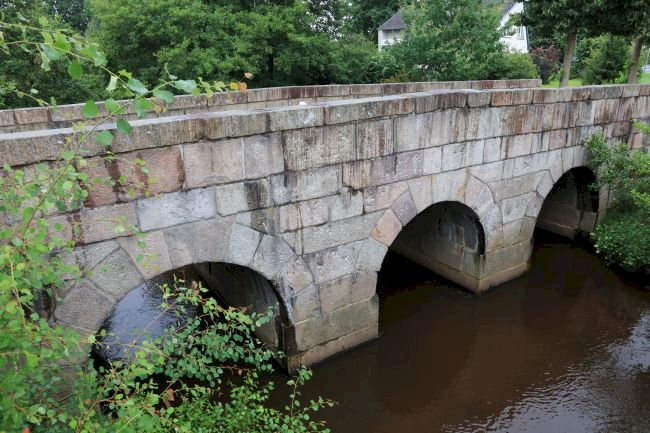
01.08.2021
© www.brueckenweb.de / Frank Sellke
Use in accordance with the terms and conditionsGermany
Schleswig-Holstein
Schmalfeld
Narrow fields au
today only pedestrian/bike path
arch bridge, arch under the roadway
Stone
1785
2.88 m
21.00 m
4.66 m
0.00 m
0.00 m
0.00 m2
in operation
Wikipedia:
The bridge, made of ashlars, was built in 1785 and served until 1983. It is possibly the oldest surviving large stone bridge in Schleswig-Holstein. It is listed as a cultural monument in the state of Schleswig-Holstein and is depicted on the Schmalfeld coat of arms.
Name
The name "King's Bridge" goes back to the Danish King Christian VII, who was Duke of Schleswig and Holstein at the time the bridge was built. According to tradition, he wrote in the margin of the construction invoice (due to the high cost of 1,771 marks): "The bridge was probably built of gold."<<
Another version reports that Christian VII took a closer look at the bridge on a trip to Hamburg and finally remarked: "It's only made of stone, and I thought it was made of gold (silver)."
History
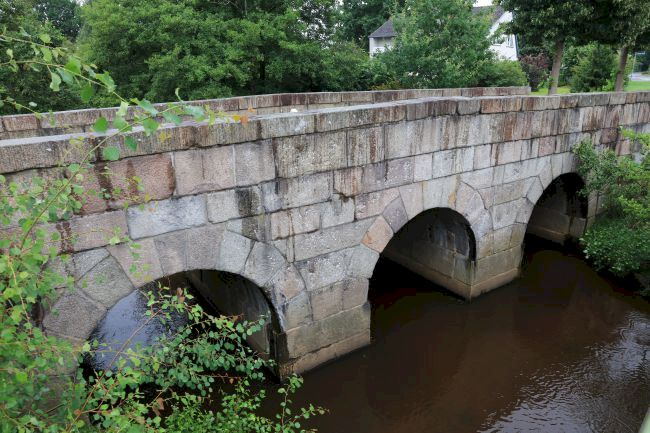
The crossing of the Schmalfelder Au was originally a ford, approximately 50 meters downstream of the present-day bridge. One of the important north-south routes and a branch of the Oxen Way ran here. A wooden bridge was first mentioned in writing in 1703. This was replaced in 1785 by the current stone arch bridge. The structure is made of hewn granite blocks. The 21 m long bridge spans the Schmalfelder Au in three arches. It is 5.5 m wide (4.66 m of which is the roadway) and is bordered on the sides by a low stone wall. The road surface on the bridge is made of cobblestones. The foundation consists of 136 beech piles, four meters long and 25 cm in diameter. The local population was involved in the construction, working for free. The Königsbrücke served without major repairs for almost 200 years until 1983. Since then, traffic on the L 234 state road has been carried over a new reinforced concrete bridge, east of the old one. The old bridge was declared a listed monument and extensively restored from 1985 to 1987. It may only be used by pedestrians and cyclists.
The bridge, made of ashlars, was built in 1785 and served until 1983. It is possibly the oldest surviving large stone bridge in Schleswig-Holstein. It is listed as a cultural monument in the state of Schleswig-Holstein and is depicted on the Schmalfeld coat of arms.
Name
The name "King's Bridge" goes back to the Danish King Christian VII, who was Duke of Schleswig and Holstein at the time the bridge was built. According to tradition, he wrote in the margin of the construction invoice (due to the high cost of 1,771 marks): "The bridge was probably built of gold."<<
Another version reports that Christian VII took a closer look at the bridge on a trip to Hamburg and finally remarked: "It's only made of stone, and I thought it was made of gold (silver)."
History
The crossing of the Schmalfelder Au was originally a ford, approximately 50 meters downstream of the present-day bridge. One of the important north-south routes and a branch of the Oxen Way ran here. A wooden bridge was first mentioned in writing in 1703. This was replaced in 1785 by the current stone arch bridge. The structure is made of hewn granite blocks. The 21 m long bridge spans the Schmalfelder Au in three arches. It is 5.5 m wide (4.66 m of which is the roadway) and is bordered on the sides by a low stone wall. The road surface on the bridge is made of cobblestones. The foundation consists of 136 beech piles, four meters long and 25 cm in diameter. The local population was involved in the construction, working for free. The Königsbrücke served without major repairs for almost 200 years until 1983. Since then, traffic on the L 234 state road has been carried over a new reinforced concrete bridge, east of the old one. The old bridge was declared a listed monument and extensively restored from 1985 to 1987. It may only be used by pedestrians and cyclists.
A map is loading