BAS 119857
Victoria Bridge

Keine weiteren Bilder verfügbar
New Zealand
Waikato
Hamilton City
Bridge Street, Hamilton
Waikato River
Street
Arch bridge, arch under the roadway
Steel
1909-1910
103.60 m
150.00 m
6.90 m
0.00 m
0.00 m
0.00 m2
in operation
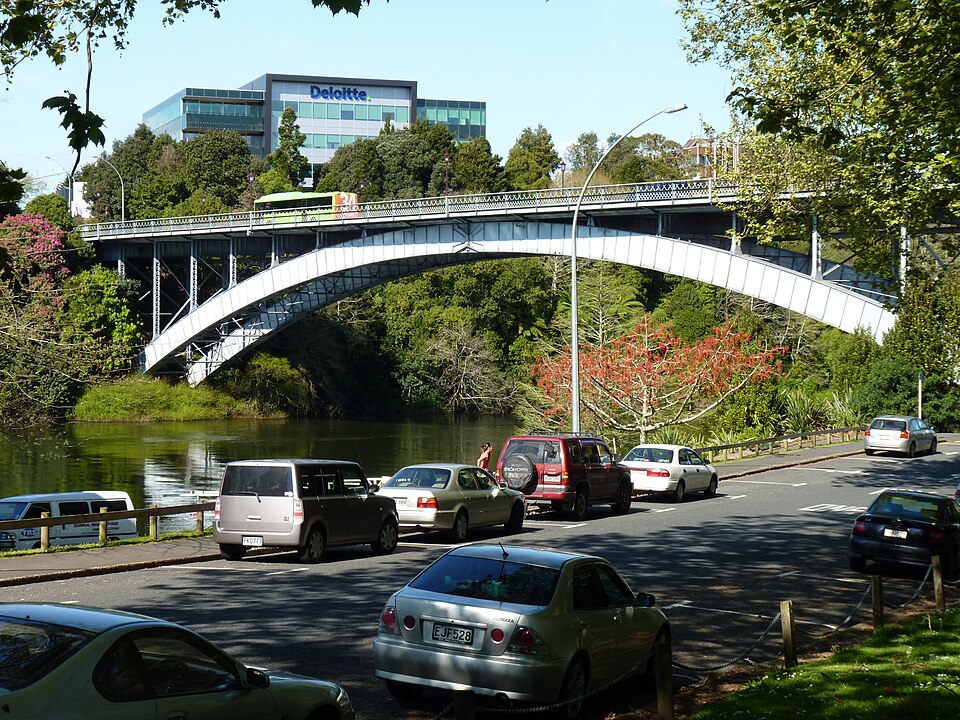
The Victoria Bridge is an elegant road bridge spanning the Waikato River in Hamilton. Its construction, upon its opening in 1910, represented a remarkable feat of urban planning and engineering. The 152-meter-long steel arch bridge formed the main link between the two suburbs of Hamilton East and West, which had grown up around two military redoubts built during the Third New Zealand War, also known as the Waikato War (1863–1864). Built on the site of the colonial settlement's first ferry crossing, the bridge replaced a wooden structure from the 1870s, symbolically known as the Union Bridge. It also held broader significance as it spanned the main road between Auckland and Rotorua. The new bridge was both functional and a symbol of progress. It was built by Hamilton Borough Council following a public referendum and at considerable expense. The bridge was constructed during a period of greater local government influence and Hamilton's rapid development. The bridge is a spandrel bridge with a 104-meter-long, three-hinged central arch and two approach spans. Its design was unusual for New Zealand due to the combined length and low height of the main span. It is believed that the design was partly conceived by Waddell and Harrington of Kansas City, who had designed the world's first lift bridge, while the renowned New Zealand engineer James Fulton oversaw the construction for the city. The international nature of the project was further emphasized by the fact that the steel structure was prefabricated in Great Britain by the Cleveland Bridge Company and shipped to the site for assembly. The original reinforced concrete roadway was designed for trams and accommodated two lanes of traffic with a separate pedestrian walkway. Subsequent settlement of the foundation led to the installation of a lighter steel frame structure in the 1930s, considered the first of its kind outside Canada. This was removed in 1992 for safety reasons during roadway widening. The Victoria Bridge is of national importance as one of New Zealand's most elaborate steel arch bridges built by a local authority. It was an ambitious project, designed and supervised by nationally and internationally renowned engineers. It enhances our understanding of New Zealand's engineering and trade relations with North America and Great Britain and makes a valuable contribution to the history of transport and technology in New Zealand, including the increase of motorized traffic in provincial towns. The structure has considerable historical value as it demonstrates the leadership and ambition of local authorities, including county councils, in the years following New Zealand's accession to the Dominion in 1907. It reflects Hamilton's growth and prosperity at the beginning of the 20th century and its position as the most important settlement in the Waikato region. The bridge is significant because it marks the first crossing of the Waikato River in colonial Hamilton and is a major local landmark. It enjoys high public esteem as an elegant addition to the cityscape and has added value through its connection with other historic bridges over the Waikato River.
Hamilton City Council
A map is loading