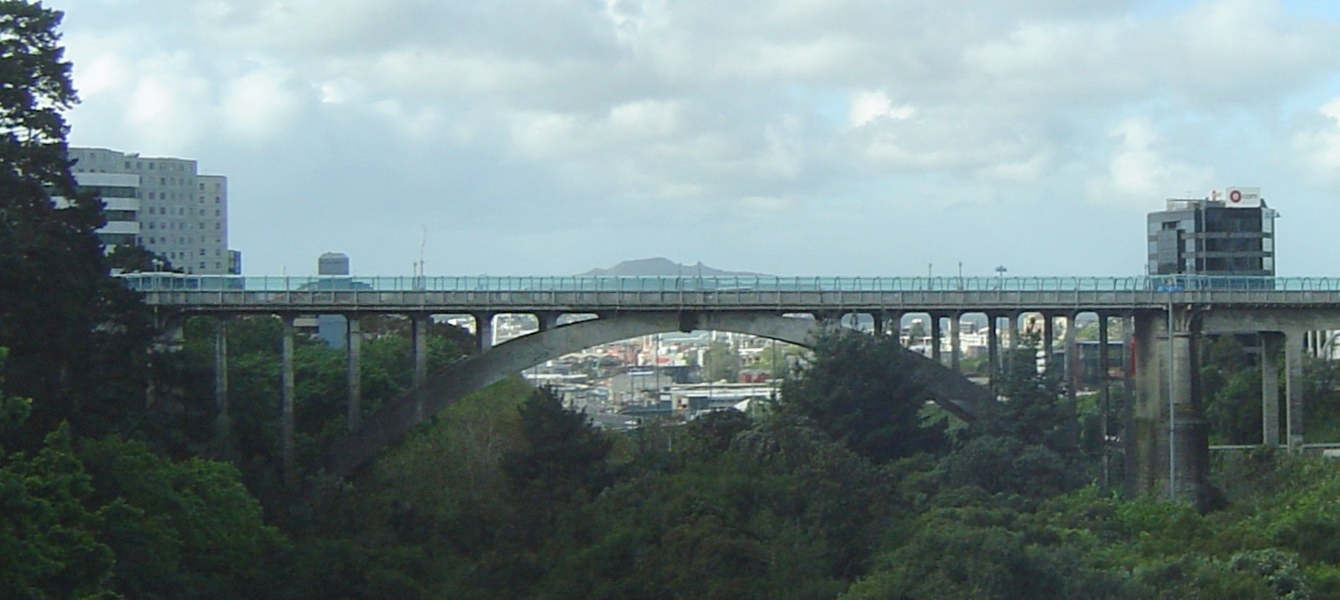
The Grafton Bridge was technologically advanced when it was built between 1907 and 1910, boasting the world's largest single reinforced concrete span. Spanning the Grafton Gully at a prominent location in Auckland, the bridge was commissioned by the City Council to connect the city center with the new hospital and sports facilities in Auckland Domain. Its construction was part of a regional road program and symbolized both the creation of Greater Auckland and the state's leadership in technological development. Approved by taxpayers at the end of the British colonial period (1840–1907), it also demonstrated the young Dominion's ability to be a global leader with its progressive thinking. Work was started by the Ferro-Concrete Company of Australasia but completed by City Council staff after the project's scale drove the original contractors into bankruptcy. The bridge has a large central span of 97.6 m, with three smaller spans on its eastern approach and six on its western approach. The 296-meter-long bridge, constructed entirely of reinforced concrete, features what were then the world's longest continuous reinforced concrete girders. Electric street lighting—unusual in the early 20th century—illuminated the elevated walkways, and the bridge was designed for two-way traffic. Little maintenance was required for the first few decades, although two refurbishment programs were undertaken in the 1930s and 1950s. The bridge remains a vital traffic artery today and underwent further minor modifications in the 1990s. The Grafton Bridge is of national and international importance due to its advanced concrete technology and is a significant symbol of national and civic pride. It is of great value as a major construction project initiated and completed by the local authorities. The structure provides valuable information about the development of road transport and was the first major road bridge in Auckland. It played a vital role in the lives of Auckland residents as a link to Auckland Hospital and the recreational areas of Auckland Domain. The structure, whose foundations were built on an early colonial cemetery, testifies to the bourgeois attitude of the early 20th century towards the past and the dead. As a prominent landmark, it possesses great value and is part of a larger historical landscape that also includes the cemetery on Symonds Street.
 Creative Commons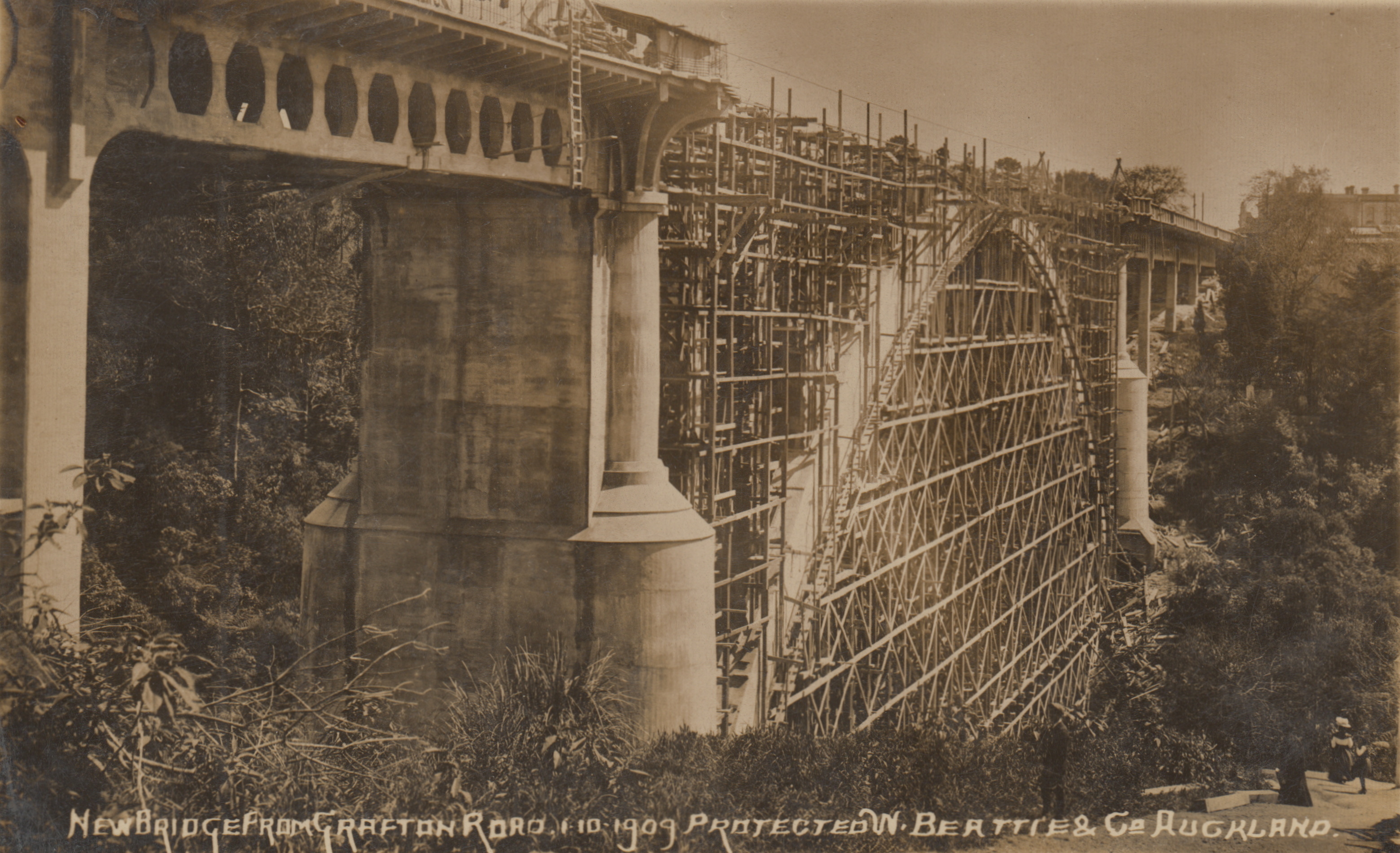
 Public Domain