BAS 119885
Railway bridge (Blair)

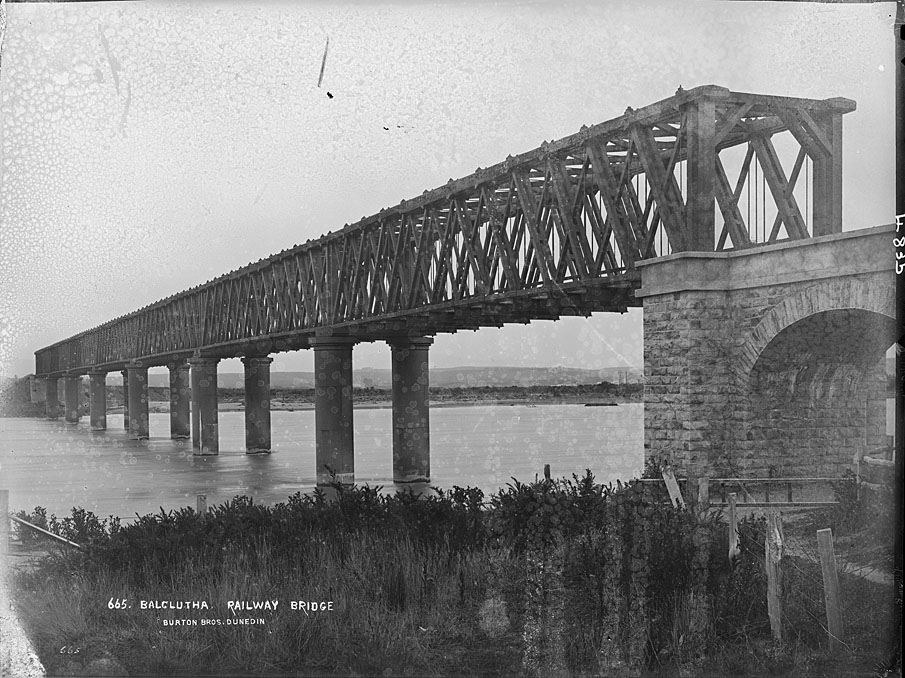
die alte Holzfachwerkkonstruktion von 1880
18.04.2026
 Public Domain
New Zealand
Otago
Balclutha
Main line south, between North Balclutha and Balclutha, BALCLUTHA
railroad
Truss bridge
Steel
Umbau 1966 bis 1978
0.00 m
0.00 m
0.00 m
0.00 m
0.00 m
0.00 m2
in operation
The Blair Bridge, named after its engineer William Blair, spans the Clutha/Mata-au River near Balclutha in South Otago and is a reminder of the importance of the railway in 19th-century New Zealand. It is historically and technologically significant, having provided vital links for passengers and freight on the main line. Railway construction was crucial to New Zealand's development. Governor Sir George Bowen broke ground on the Dunedin-Balclutha railway line on March 18, 1871. Four years later, this section was opened to traffic. The train would pull into the siding at the Clutha River, and a steamboat would take passengers to the opposite bank. Building a bridge over the mighty Clutha was the next step. In 1873, the Department of Public Works drew up a plan of the proposed bridge location. District Engineer William Newsham Blair designed the bridge. Blair (1841–1891) was born in Scotland. After his initial apprenticeship at an engineering and surveying office in Oban in 1861, he joined the firm of Sir Thomas Bouch, the builder of the Tay Bridge. In 1863, he arrived in New Zealand and in 1864 became an employee of the Otago Provincial Council. His work mainly involved railways, railway and road bridges, waterworks, and the port of Port Chalmers. In 1871, he was appointed District Engineer of Dunedin in the Ministry of Public Works. In 1878, he became Chief Engineer of the South Island. He was heavily involved in planning the expansion of the railways on the South Island, particularly the connections from Canterbury to the West Coast and to Nelson. In 1884, he was appointed Deputy Chief Engineer of the Ministry and participated in the planning of the main line of the North Island. In 1890, he became Chief Engineer and Secretary of State in the Ministry of Public Works. The contractor was James Mackay. The first contract for the seven 36-meter-long wooden bridge spans was awarded in 1874 for £21,253. The 2.1-meter-high piers each consisted of two cast-iron piles filled with concrete and ranged in height from 17.1 to 24.3 meters. The northern abutment spans the Kaitangata Highway and features a stone arch. At the time of its construction, the bridge was, according to architect and engineering historian Geoffrey Thornton, the largest bridge of its kind on the South Island. The Minister of Works, William Larnach, opened the bridge on January 22, 1878, and named it Blair Bridge. The main line to Invercargill was completed in January 1879. Since its construction, the bridge, designated "Bridge 297" by the railway authority, has required numerous repairs and reinforcements. Finally, between 1966 and 1978, the wooden girders were replaced with steel truss bridges.
The Blair Bridge is still in operation on the Main South Line in 2015.
The Blair Bridge is still in operation on the Main South Line in 2015.
A map is loading