BAS 13169
SBS Wittenberge / Elbe
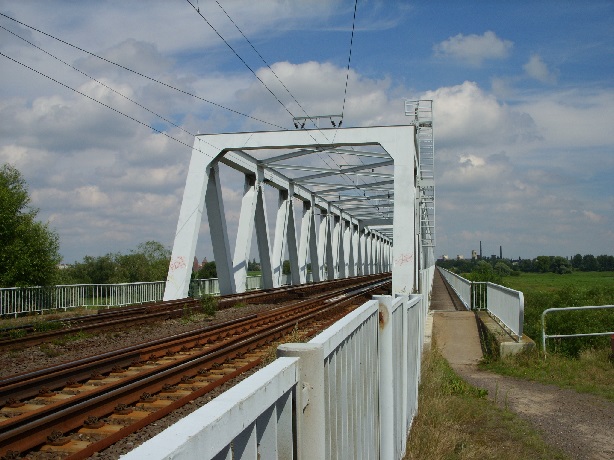
23.07.2007
© Nachtschicht
 No other use permitted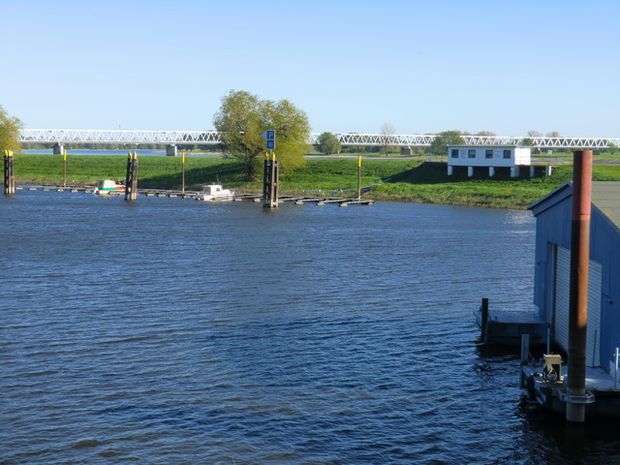
EÜ Wittenberge / Elbe
30.4.2011
© Helmut Fischer
 Use only on request
Germany
Brandenburg, Saxony-Anhalt
Wittenberge
in the LK Prignitz and Stendal, South-southeast of the city
Elbe
Railway of line Wittenberge - Salzwedel, Stendal, cycling track and footpath
Truss bridge
1848-1851, 1883/84, 1909/10, 1982-1987
1848-1851, 1883/84, 1909/10, 1982-1987
0.00 m
1030.00 m
0.00 m
0.00 m
0.00 m
0.00 m2
in operation
In June 1847, the Magdeburg - Wittenberg ash railway company began construction of the first 1443-metre bridge turn across the Elbe. This consisted of Elbe with Diametres of 18.9 meters and a 345-metre Earth Dam starting on the eastern shore a masonry arch bridge with five arches over the Dove. An iron swing bridge with two openings of the 12.6 meters and an intervening 8.8 metres thick pillars as well as a wooden truss with 14 holes, three fields with 40 metres of clear span and eleven fields with 54 m of clear span, were arranged in the current range. This was followed by a flood bridge made of masonry vaults with twelve arches and 18.9 metres of clear span.<br><br>The wooden diamond truss bridge was a Howe supporting structure with truss poles from the iron rod. 16 Pillars were established on stake racks from wooden poles. A bridge superstructure with 54 metre has undergone successfully numerous load tests and advance assembled on the building site.<br><br>The first single-track bridge, whose Pfeiler were designed for a second track was completed on 28 October 1851. She cost 1.186.942 dollars. After the installation of a Bohlenbelages for a 4.1-meter-wide road, the building from 1852 during breaks in train traffic from road transport could be used. Between 1883 and 1884, the wooden structure was replaced by a wrought iron truss structure.<br><br>From 1909 to 1911 was a complete renovation of the current bridge. The swing bridge was replaced by a steel truss bridge with folded top flange and approximately 37.2 meter wingspan. The following two fields of bridges were running through a field with a steel truss bridge, as 11.5 meters high semi parabolic carrier exciting 84 meters, replaced. Also the remaining buildings were replaced by Schwedlerträger with 55.2 meters wingspan (West end field 41.1 meters) and below the roadway. In addition, for the second track in the sparse distance of 1.4 metres a second bridge train mounted and thereby the southern track constructed by mounting a pavement for use as a road bridge. The current bridge had thus 14 fields.<br><br>At the end of the second world war, on April 12, 1945, the two last buildings before the banks of Wittenberg and the intervening power pillars were blown up. A single-track wooden makeshift bridge erected in the autumn of 1945 by Russian troops allowed the railway operations at short notice again. In April 1946, the Reichsbahn mounted two steel remedy above buildings of the system of "Roth-Wagner" after restoration of the ruined pillar of power as a substitute for the southern track. 1947 followed the remedy above buildings for the Northern bridge train, which was however used as Flyover due to the dismantling of a track.<br><br>Equipped in this State--with only one track and the permissible train speed reduced to 30 km/h - the bridge structure remained until 1950. This year was the commissioning of the second track using the baseboard Stendal-Wittenberge by road transport.<br><br>Because the line Magdeburg-Wittenberge was one of the important North-South connections in the GDR, the remedy above buildings were replaced between the years 1955 and 1957 by new rule above buildings. The additional road traffic on the bridge ended in 1976 with the opening of the new road bridge across the Elbe.<br><br>Due to the electrification of the railway line the complete, approximately 70-year-old bridge train was replaced between the years 1982 and 1987 by a 1030 metres long. It was the longest bridge construction of the Deutsche Reichsbahn in the GDR. The 14-fürstenmoor bridge has three continuous beams with five twice and once four fields as building system in the longitudinal direction and is made of steel as pfostenloses Struts framework. The tracks are mounted without gravel bed directly to the bridge under construction. A footbridge is present on the upper stream side. The vertical clearance for ships is 6.10 m. Thus, the building is one of the low bridges that span the river Elbe. (Source: Wikipedia)
A map is loading