brueckenweb-logo
discover
Icon
bridges
Icon
bridge search
Icon
nearby
Icon
most bridges records
Icon
disasters
Icon
country overview
Icon
collections
Icon
articles
Icon
bridge news
Icon
literature
Icon
store
Icon
Icon
pinboard
Icon
Icon
clubinfo
join in
only for registered club members
administrate
only for registered club members

    1999 - 2026 © Frank Sellke / brueckenweb.de

    Icons by Icons8.com

    Version 5.1.16

    Legal Notice | Privacy Policy | ⚠️ Vertrag widerrufen

    BAS 1341
    Berlin Bridge
    Brückenbild

    1965

    © Postkarte

    verboten / prohibitedNo other use permitted
    Bild 1

    18.01.2026

    © www.brueckenweb.de / Frank Sellke

    gegen Entgeld / for a feeUse in accordance with the terms and conditions
    Bild 2

    18.01.2026

    © www.brueckenweb.de / Frank Sellke

    gegen Entgeld / for a feeUse in accordance with the terms and conditions
    To Bridge Images
    Germany
    North Rhine-Westphalia
    Duisburg
    Ruhr / Port
    A59 motorway
    haunch girder / beam bridge
    Steel
    Verkehrsfreigabe: 06.09.1965
    84.00 m
    1824.00 m
    0.00 m

    A map is loading

    Timeline

    Loading timeline...

    Tags

    Loading tags ...

    Editing is available for members (midgr >= 6).

    News

    Lade Nachrichten ... loading news ...

    Links

    Loading links ...

    Literature

    Loading literature ...

    Collectibles

    Loading collectibles ...

    Videos

    Loading videos ...

    Documents

    Loading documents ...

    0.00 m
    0.00 m
    0.00 m2
    in operation

    at the opening >>>Largest steel bridge in Europe<< (Text on a postcard)

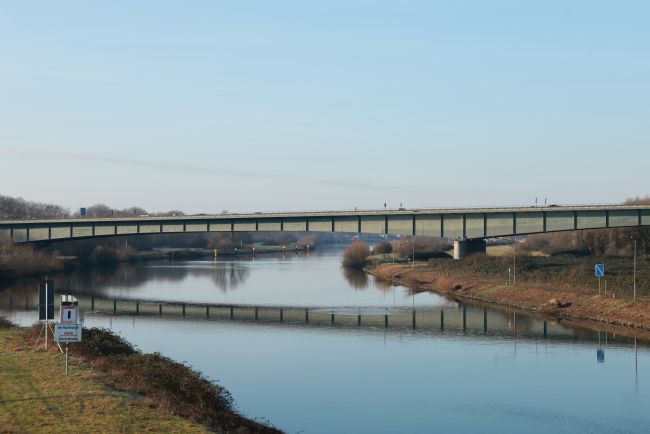
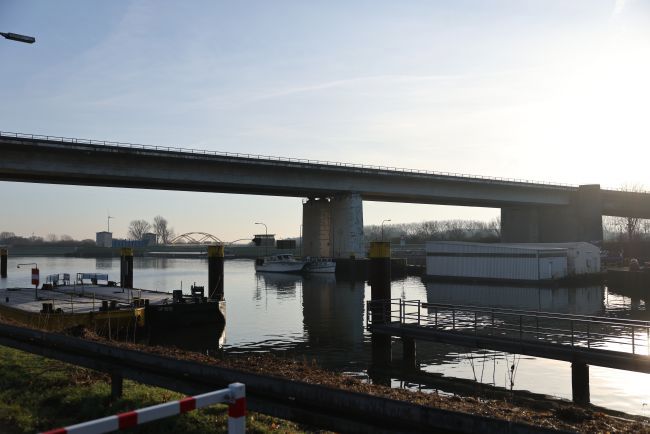
    The Berliner Brücke in Duisburg, with a length of 1824 meters, is the sixth longest road bridge in Germany.

    History
    After the end of the Second World War, Duisburg was developed into a car-friendly city. The bridge is part of the North-South Road, the first urban motorway in (West) Germany, today a section of the A59 motorway. Since the federal government declined to provide financial support for the project, the city financed the construction of the road itself. Officials in West Berlin became aware of the construction project as early as 1960. On July 8, 1960, the then Governing Mayor of Berlin, Willy Brandt, attended the laying of the foundation stone.[1]

    Willy Brandt opened the Berliner Brücke on September 6, 1963, after three years of construction. As a sign of solidarity with the inhabitants of Berlin, it was named "Berliner Brücke" (Berlin Bridge), a name also expressed by the double sculpture "Begegnungen" (Encounters) by the Berlin artist Ursula Hanke-Förster at the southern end of the bridge.[2] This sculpture depicts two stylized groups of people waving to each other, separated by the newly built road.

    The construction of the bridge was fraught with difficulties. For example, the Duisburg local press criticized the six-month delay in its inauguration. The total estimated cost for the construction – DM 49,942,000 – was not exceeded.

    Bridge Complex
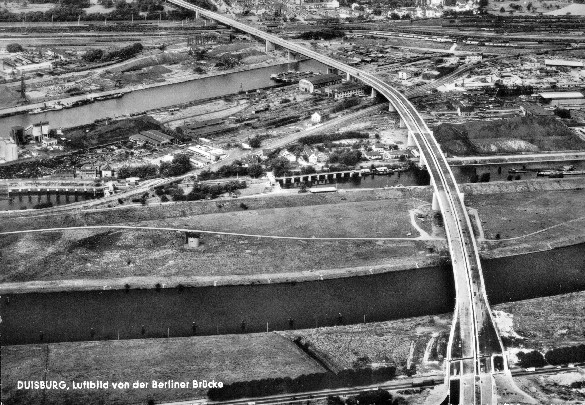
    • The bridge consists of 7 individual bridges of different designs arranged one after the other (from north to south):
      City Park Bridge 328.15 m prestressed concrete
      Freight Yard Bridge 314.34 m steel
      Harbor Basin Bridge 274.17 m steel
      Industrial Bridge 316.32 m prestressed concrete
      Rhine-Herne Canal Bridge 219.13 m prestressed concrete box girder (RHK 302a)
      Ruhr Bridge 347.30 m steel
      Ruhr Dike Bridge 24.97 m Reinforced concrete