BAS 1782
Volmetal Bridge
15.05.2020
© www.brueckenweb.de / Frank Sellke
 Use in accordance with the terms and conditions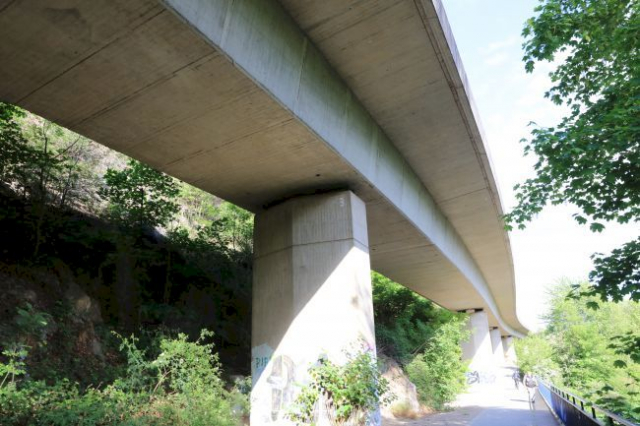
nördliche Zufahrtsrampe
15.05.2020
© www.brueckenweb.de / Frank Sellke
Use in accordance with the terms and conditions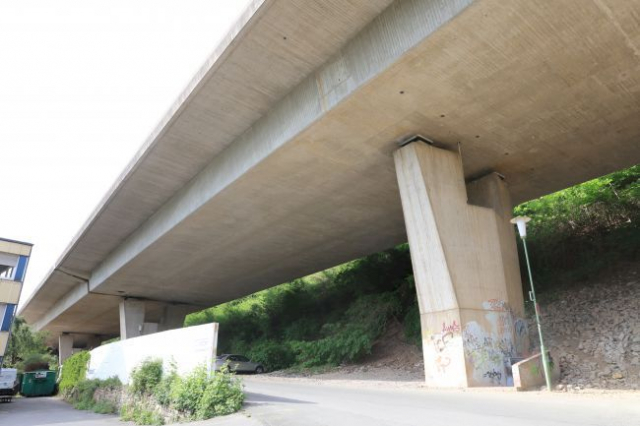
15.05.2020
© www.brueckenweb.de / Frank Sellke
Use in accordance with the terms and conditionsGermany
North Rhine-Westphalia
Hagen
Volme, railway, roads
Road B54
Beam bridge
concrete
1971 bis 1977
44.00 m
1740.00 m
0.00 m
0.00 m
0.00 m
0.00 m2
in operation
Wikipedia:
The Volmetal Bridge is a 1,740 m long elevated road on the northeastern edge of Eilpe, a district of Hagen.
The bridge is located along Volmetalstraße, a section of Bundesstraße 54, and spans, among other roads, the Volme River, the Volmetalbahn, state roads 528 and 693, and other city streets. The bridge has two lanes for most of its length, with four lanes in the middle section.
The structure consists of a superstructure. The bridge was built in sections between 1971 and 1977, using available funds. It was originally planned as part of an urban highway.
Construction
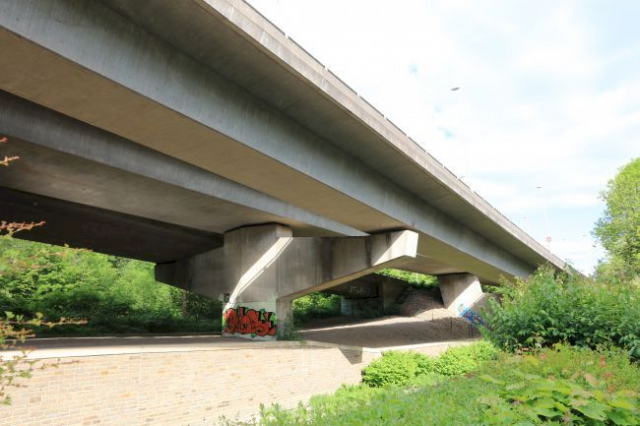
The structure is a prestressed concrete girder bridge with 41 openings. The bridge superstructure has a box girder cross-section with a uniform structural height of 2.42 m and slightly sloping webs. It is divided longitudinally into six continuous girder sections, each separated by expansion joints. The superstructure is generally supported by centrally arranged piers with a solid hexagonal cross-section and shallow foundations.
The first, northern bridge section has seven openings and a length of 285.3 m. The spans in the western end span are 25.3 m, followed by four spans of 43 m and two spans of 44 m. The box girder cross-section has one cell and a deck width of 10.5 m.
The second bridge section again has seven openings and, with uniform spans of 44 m, a length of 308 m. Due to the possibility of a later connection, this bridge segment initially has a five-cell bridge cross-section with a width of 31.8 m, which transitions into a three-cell cross-section with a width of 23.0 m in the four-lane road section.
The next bridge section has eight openings and, with uniform spans of 44 m, a length of 352 m. The box girder cross-section has three cells and a deck width of 23 m.
The fourth bridge section again has seven openings and, with uniform spans of 44 m, a length of 308 m. The box girder cross-section reaches a maximum width of 33.2 m in front of the side entrance and exit ramps. The eastern approach ramp bridge is 124.8 m long, and the western exit ramp is 258.8 m long. The remaining section of the main bridge superstructure has a two-cell cross-section with a width of 15.0 m.
The fifth bridge section has nine openings and, except for the last span with a 36 m span, spans of 44 m, resulting in a total length of 388 m. The box girder cross-section has two cells and a deck width of 15 m.
The final, 99 m long bridge section consists of three spans with a uniform span of 33 m. It has a t-beam cross-section, whose width increases from 19 m to 24 m due to the addition of an exit ramp. The ramp bridge is 253.1 m long.
Construction
The first three bridge segments, except for the section with the bridge widening, were constructed using a launching scaffold; the remaining sections, including the ramp bridges, were constructed using a movable falsework.
Literature:
Hans-Georg Borck, Hans Wittfoht: The Volmetalstraße Bridge in Hagen. In: Beton- und Stahlbetonbau, 1979, pages 265–271.
The Volmetal Bridge is a 1,740 m long elevated road on the northeastern edge of Eilpe, a district of Hagen.
The bridge is located along Volmetalstraße, a section of Bundesstraße 54, and spans, among other roads, the Volme River, the Volmetalbahn, state roads 528 and 693, and other city streets. The bridge has two lanes for most of its length, with four lanes in the middle section.
The structure consists of a superstructure. The bridge was built in sections between 1971 and 1977, using available funds. It was originally planned as part of an urban highway.
Construction
The structure is a prestressed concrete girder bridge with 41 openings. The bridge superstructure has a box girder cross-section with a uniform structural height of 2.42 m and slightly sloping webs. It is divided longitudinally into six continuous girder sections, each separated by expansion joints. The superstructure is generally supported by centrally arranged piers with a solid hexagonal cross-section and shallow foundations.
The first, northern bridge section has seven openings and a length of 285.3 m. The spans in the western end span are 25.3 m, followed by four spans of 43 m and two spans of 44 m. The box girder cross-section has one cell and a deck width of 10.5 m.
The second bridge section again has seven openings and, with uniform spans of 44 m, a length of 308 m. Due to the possibility of a later connection, this bridge segment initially has a five-cell bridge cross-section with a width of 31.8 m, which transitions into a three-cell cross-section with a width of 23.0 m in the four-lane road section.
The next bridge section has eight openings and, with uniform spans of 44 m, a length of 352 m. The box girder cross-section has three cells and a deck width of 23 m.
The fourth bridge section again has seven openings and, with uniform spans of 44 m, a length of 308 m. The box girder cross-section reaches a maximum width of 33.2 m in front of the side entrance and exit ramps. The eastern approach ramp bridge is 124.8 m long, and the western exit ramp is 258.8 m long. The remaining section of the main bridge superstructure has a two-cell cross-section with a width of 15.0 m.
The fifth bridge section has nine openings and, except for the last span with a 36 m span, spans of 44 m, resulting in a total length of 388 m. The box girder cross-section has two cells and a deck width of 15 m.
The final, 99 m long bridge section consists of three spans with a uniform span of 33 m. It has a t-beam cross-section, whose width increases from 19 m to 24 m due to the addition of an exit ramp. The ramp bridge is 253.1 m long.
Construction
The first three bridge segments, except for the section with the bridge widening, were constructed using a launching scaffold; the remaining sections, including the ramp bridges, were constructed using a movable falsework.
Literature:
Hans-Georg Borck, Hans Wittfoht: The Volmetalstraße Bridge in Hagen. In: Beton- und Stahlbetonbau, 1979, pages 265–271.
A map is loading