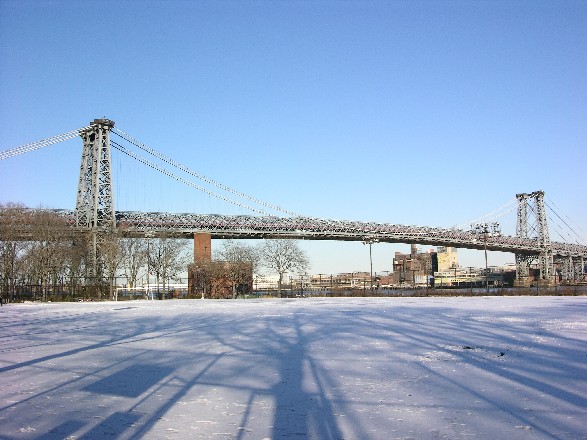
19.02.2007
 Use in accordance with the terms and conditions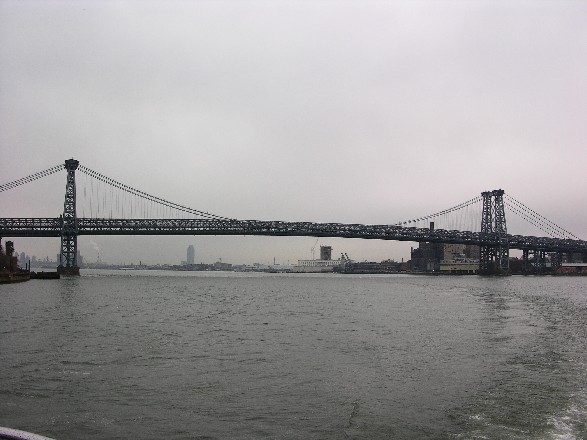
22.02.2007
© Frank Sellke / brueckenweb.de
Use in accordance with the terms and conditions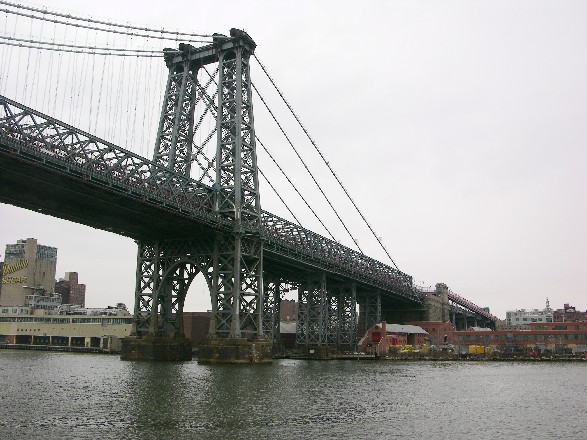
22.02.2007
© Frank Sellke / brueckenweb.de
Use in accordance with the terms and conditions12.2 m high stiffening trusses, lattice steel pylon (first steel pylon) steel superstructure length 918 m<br><br><br>The first plans for the Williamsburg Bridge in 1896 first met with skepticism on little. For the first time, the pylons should be constructed in steel truss. There was also a change of the Framework of the stiffening beam on the pylon provided over the river was below the truss above the road surface, in the page fields. This was in the running in a continuously about the Roadway lying trussed changed.<br><br>Through the proximity to the Brooklyn Bridge, the in Sight is located, was a suspension bridge in planning from the outset. A cantilever bridge, which were at that time very popular, was not in Consider pulled. Aesthetics were equally important as economic, and both influenced the execution design. So were the suspension cable of the pylons led straight to the abutments, without the page fields to wear. As a result the cable could significantly be carried out easier and shorter. By the light Smaller foundations could be built steel construction of pylons, a large portion of the costs make that for all bridges. The pure truss structure took some persuasion, in one It meant contemporary report: "roughly speaking, would" Stone towers require a twice as large foundations, would five times as much cost and three times as long to continue [99].<span style="mso-spacerun: yes"> </span>Furthermore, the lighter steel towers could be higher as Stone towers, and as a result the cable got a deeper arc, what would lower tension and thus a smaller diameter the result.<br><br>The construction began in 1901 and was in full On the 1.1.1902 as a bridge Commissioner appointed way as Gustav Lindenthal was and replaced buck as Chief Engineer.<br>The suspension cable were the John A. Roebling's Sons company spun, and had huge problems, the the Completion was delayed by several months. The four wires with a 476 Mm ever 7696 parallel wires in diameter were originally through a sealing coat of linseed oil, a double coat of thick Protected oil and graphite. In addition, the wires were in a asphalt-impregnated sheet packed and wrapped with wire.<br><br>The bridge was a problem from the start. Three years after its completion there was problem with stability. The pylons is slightly moving towards Brooklyn. As a countermeasure were also supports the page fields. The increasing Transport, in particular the serious sub way trains made a reinforcement program from 1911 necessary. Ten years later it investigated the suspension cable and discovered heavy Korrossionsschäden on its cover, while the wires still were relatively well preserved. The cover was by galvanized wires renewed and supplemented the linseed oil. the oil had again in 1944 and 1963 to be renewed.<bR><br>During an inspection of 1979 were very strong Corrosion discovered on almost all major parts. As an immediate measure the road carrier have been repaired and every third Earrings by reinforced, new replaced. Particularly critical was the situation on the Main cables, which on the abutments hundreds wires broken and corroded. Other part, 90 per cent of the cross-sections were rusted away.<br><br>Three variants were further to the Discussion: the most cost-effective way was a renovation whole structure including the replacement of the steel track with Concrete filling by an orthotropic plate. The cost estimate alone Main suspension cable and road were well above 0 million.<br><bR>"The proposal of an engineering attracted some 1984 in New York City [Ammann & Whitney], the specialists in urban as also stately bodies were very skeptical. He sees -greatly simplified — above, under far-reaching Maintenance of traffic on the bridge the existing cable suspended structure and new larger and higher towers to transform.<bR>With the establishment of this new steel framework pylons to the existing around the rebuilding to begin; the existing river piers should be used with. Then should, starting from the pillars of that. two lane Strip in nightly block breaks the replaces existing roadway construction with an orthotropic plate be. Since this must be about 90 cm higher, she should both parties in Direction of travel are connected through makeshift ramps. The Is approximately equal to the weight of the new roadway construction old, so that no additional loads in the cables. The road construction under the two railway tracks can similarly renewed be.<br><br>With the progress of the new construction of two pylons out after both sides can also use the radiating arranged tensioning ropes attached the first are still limp stay, as long as the new design on the cross beams of the rests available.<p> <p class="MsoNormal">The most difficult construction is the tensing Inclined ropes be, because while the construction of new stands and the old also under the discharge upwards deforms. Only after full of tension inclined ropes, she can then piece by piece be removed, followed by the dismantling of vertical hangers and the Cable. Then the truss can be used as last stage be talked off the old pylons in the new.<br><br>Since the side holes only the 92 m have length, be just as much of the 488 m central opening, so 92 m from under Precompression are the pylons, the remaining 120 m in the middle of the main opening will be as a central part of a suspension bridge viewed."[5001]