BAS 2558
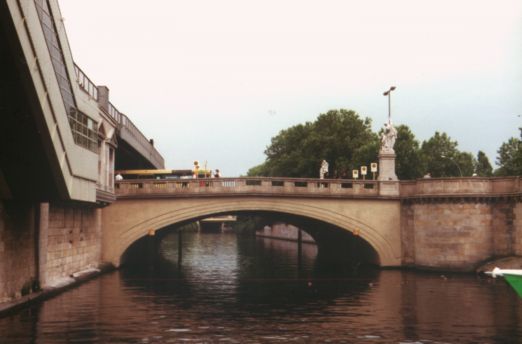
Halle Gate Bridge
© Frank Sellke / brueckenweb.de
 Use in accordance with the terms and conditions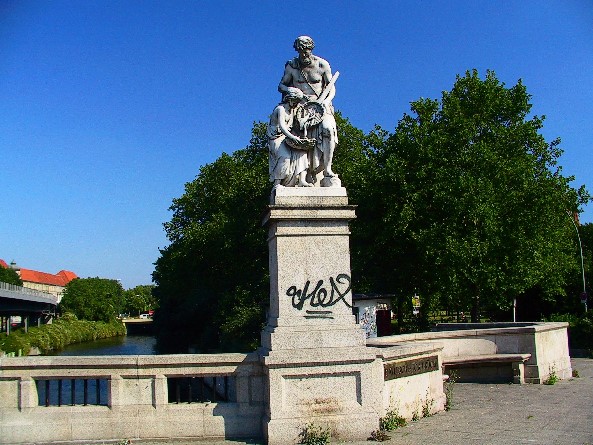
05.09.2005
© Johannes Bönisch
 Use only on request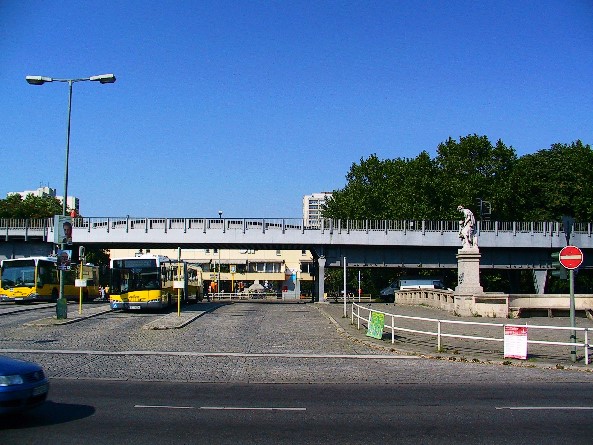
05.09.2005
© Johannes Bönisch
Use only on requestGermany
Berlin
Berlin
Berlin Kreuzberg
Landwehr Canal
Street
arch bridge, arch under the roadway
Concrete
1850-55 (Klappbrücke) 1874-76
19.00 m
0.00 m
33.00 m
0.00 m
0.00 m
0.00 m2
in operation
Www.luise-berlin.de information:<br><br>The Halle Gate Bridge is located on the elevated station Hallesches Tor and connects Hallesches UFER and Tempelhof Bank/Waterloo banks over the Landwehrkanal. The 1705 navigable made sheep trench was crossed at this point by a wooden bridge. With the expansion of the Landwehr Canal a wooden bascule bridge built in 1850, which was called to the gate of the excise wall until 1874 H.. Johann Heinrich Strack (1805-1880) designed a new bridge, which was headed by Erich Dietrich from 1874 to 1876 and renamed Belle-Alliance bridge. The basket arch bridge had a span of 18,80 m and was the widest bridge in Berlin 33,60 m at the time. The brick bridge with sandstone has been disguised. The granite rail shipping by Otto Geyer (1843-1914) and fishing by Julius Moser (1832-1916) as well as the commercial diligence by Eduard Luerssen (1840-1891) and the fruit trade (called also market transport) received four Postamente with allegorical figures by Friedrich Reusch(1843–1906). Four medallions with commercial and industrial motifs adorn the water-side view faces of the bridge. After war damage, the bridge was rebuilt in 1953 in the old forms, and bears the name H. Since 1989 the sculpture groups again raised River and fishing. The Group of sculptures of fruit trade was destroyed in the war, the whereabouts of the group commercial diligence and the medallions is unclear. 1972, A keystone was inlaid with Neptune head in a wall of the Tegel Center.
A map is loading