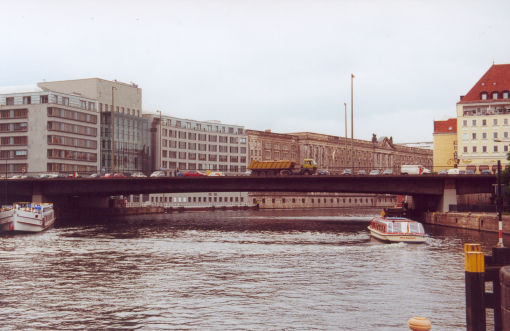
<br>The name of mill dam ("Molendam tu Berlin") comes from the time of the founding of the city, when the dam was the only fortified spree transition between the towns of Berlin and Cölln. There, laid out in the Spree Valley highways ran together. At the same time, the mill dam served as Weir and mill Dam for the water mills since 1220. The six grain - walk - and sawmills were across the River, only a centerpiece to the passage of the ship was kept clear. Since 1448, the profitable mills were in the possession of the sovereign. Here processed products were offered in simple cabins for sale on the spot. The existing stack right transhipment of ships led to the establishment of another dealer, what in turn helped the city's coffers to good revenue. The mill dam was a hive of market activity.<br><br>in 1578, the first navigable lock was built here. In 1687, the wooden stalls were built at the behest of the great elector in stone:<br>"To top it all a better look to give established the basement of the building as arcades, while on the southern side of the mill dam, the passage on the so-called fishing bridge was decorated with a high portal on its Keystone, the bust of the Prince-elector ward set up." The five courses, which currently flows the water to the mill, had over the years 1706 to 1710 the Soothè the architect of blocks run Friedrich I.."<br><br>The new sale facilities - six massive arches - were built according to plans of Johann Arnold Nering and called the Mill Colonnade.<br><br>After several fires in the following decades the colonnades were rebuilt at the beginning of the 19th century sandstone. At that time, the mill dam was a bustling commercial Street.<br><br>in 1888, a newly built 110 metre-long lock on the Mühlendamm replaced the lock several times enlarged since the middle ages in the Kupfergraben. The Spree river bed was deepened for the increasing shipping and transformed the bridge. The mills now constituted an obstacle, so were the mill closed and the buildings demolished until 1892. The existing since 1850 gristmill built like a castle of red and yellow bricks ("mill dam building") was transformed however became the seat of the municipal savings bank and poor management. For the first time, the city leaders could build a recognizable as bridge steel construction. In addition, other bridges had to be created to cross the "channel" and the Chamber lock. Seven different iron bridge constructions the lock finally linked the two banks of the river Spree. It was among other things the fishing Bridge Street Bridge and mill Dam Bridge, whose supporting consisted of cast iron and who camped on iron supports beneath the roads. The mill Dam Bridge received a 15 meter wide roadway has enormously grown carriage traffic. For pedestrians, there were walkways on both sides of 8.5 meters wide. The reserved to the pedestrians new arched Mill road bridge over the "major channel" was 4.5 meters wide and ornamental decorated.<br><br>Between 1936 and 1940 the mill dam was transformed again, where the mill dam building and the Weir disappeared, as well as the Ephraim-Palais on the corner of post Street. The outbreak of the second world war prevented the completion of the renovation work. Two each 35 metres long and 11 metres wide steel truss bridges on both sides of the lock and a steel girder bridge over the military channel were available. The bridges of the Wehrmacht were blown up in the last days of the war.<br><br>a makeshift recovery of steel structural parts that could be salvaged from the river Spree started in 1946. The repaired bridge of mill dam was opened to traffic on September 1, 1946. The installation of a modern bridge construction work was planned in the 1960s. 1964 had residues of the old sluice applications first dismantled and cleared the river Spree reason be. An unadorned dreifeldrige pre-stressed concrete bridge was built between 1966 and 1968. The bridge consists of two separate bridges parts, each part has ten metre wide walkways and several lanes. The hollow boxes contain the necessary supply lines. Upon its completion, the bridge considered the largest road bridge built in the GDR. At the time of preparation to the 750 anniversary of Berlin the Ephraim-Palais in its old place was rebuilt in 1985.
 Use in accordance with the terms and conditions
 Use only on request