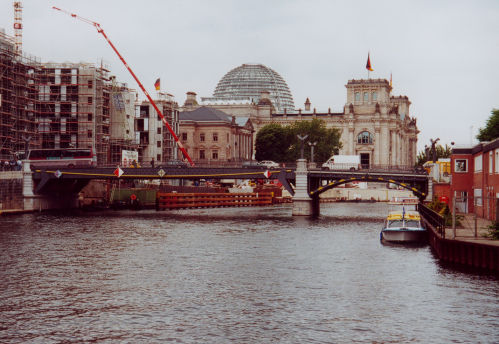
© Frank Sellke / brueckenweb.de
 Use in accordance with the terms and conditions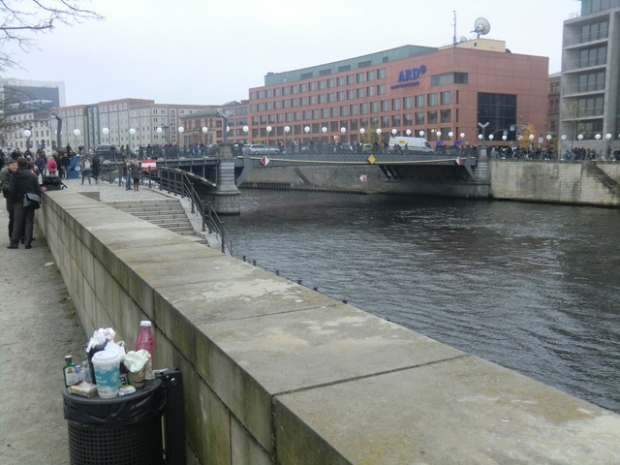
Marschallbrücke am 25. Jahrestages der Berliner Mauer
9.11.2014
© Helmut Fischer
Use in accordance with the terms and conditions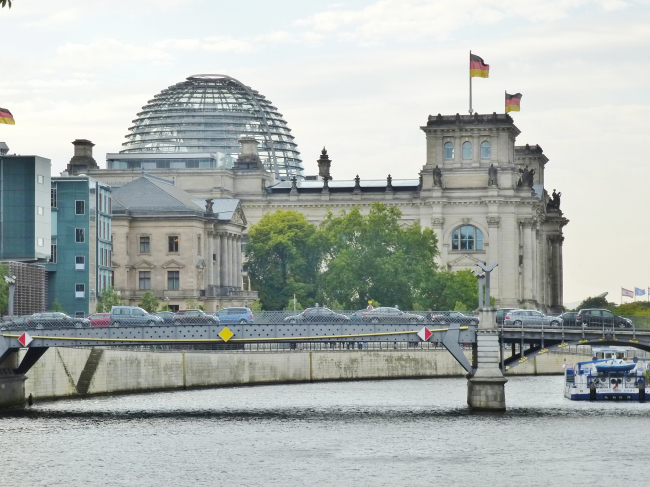
Marschallbrücke vor dem Reichstag, Bl. v. Osten
14.9.2012
© Dr. Manfred Böhmer
Use in accordance with the terms and conditions<br>Structure of prestressed concrete on the sides a facing of steel, the bridge was extensively rebuilt for shipping: remained from the original bridge only a superstructure of the three-part bridge stand as a pillar of power had to be removed.<br><br>The increased traffic between the Dorotheenstadt and Friedrichstadt William as well as the reliability and the narrow road of the Marshal bridge led to a new building by the Berlin magistrate in order. 1881/82 the new bridge was built first generation according to plans by Eduard Albert Paul Gottheiner iron - and steel-bridge, as she came back several times in downtown Berlin to run. It consisted of three wrought iron two joint timber arches and was stored on two electricity pillars clad with granite in the spree. She received rich decoration with wrought-iron candelabra on the pillars, ornamental bridge railing and separate metal reliefs on the arch parting.<br><br>As more than 20 Berlin bridges over the spree, the Marshal bridge suffered 1945 strong through a blast damage, which the armed forces wanted to prevent the advance of the Red Army in Berlin City Centre. Immediately after the end of the second world war the destroyed southern arch with steel girders fixed makeshift. The makeshift structure served the pedestrians, but especially to transfer a debris line with which the ruins of the nearby government buildings have been removed. The bridge was then equipped with additional steel beams, a new railing and a new Taira. Due to its proximity to the Berlin wall built in 1961 and in this area is not very heavy traffic, no further repair or renovation work have been made for decades. The fall of the Berlin wall brought a huge increase in the volume of traffic of the Marshal bridge. In the years from 1997 an overhaul was inevitable, where the builders wanted to get the remaining remnants of the iron truss at the same time. The requirements of ship traffic on the river Spree, the wishes of the national monument Institute, and static constructive necessities were combined using a tag competition to a workable compromise. The architect Benedict tonon and the bridge engineer Gerhard Pichler submitted draft came to run, which provided for the preservation of existing bridge elements. The construction company "Schmitt Stumpf Frühauf" and implement the plans "Sächsische Maschinenbau GmbH". For the widening of the fairway was the southern pillar of power removed and clamped a new steel structure between the southern abutment and the remaining, restored in the original form, but deeper founded North pillar. The salvaged medium arch construction by tonon was integrated into the new Hitchhiker Steg (BAS 2552) at the German Museum of technology. The best-preserved old girder arches were rebuilt to two accompanying pedestrian bridges. A contrasting color and contrasting bridges elements determine the appearance of the Marshal bridge, which could keep their 1990 certain monument despite this tags.
A map is loading