BAS 3254
Castielerviadukt
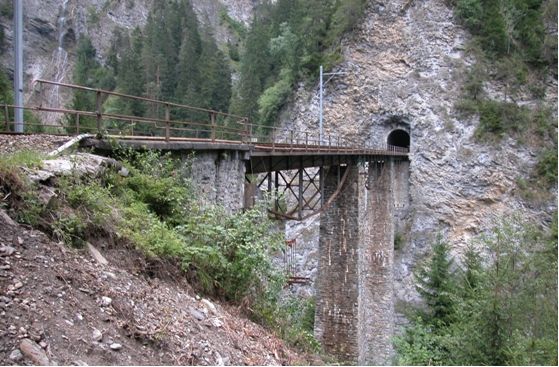
Juli 2003
© Rhätische Bahn (RhB)
 Use only on request
Keine weiteren Bilder verfügbar
Switzerland
Graubünden
Castiel
Castielertobel
Railway (RhB track Untersaz - Lüen Castiel km 6,844)
Truss bridge, former arch bridge, bow under the roadway
Steel, stone
1913-1914 (RhB: 2006)
28.05 m
91.80 m
0.00 m
53.00 m
0.00 m
0.00 m2
in operation
Wikipedia:<br><br>Location [edit]

The building is part of the narrow-gauge railway from Chur-Arosa and Castiel and Calfreisen is located. It is the third largest of the Arosa line bridge after the Langwieser Viaduct and the Gründjitobel viaduct. The viaduct leads the railway line approximately 330 meters below the bridge of the Schanfiggerstrasse on the Castielertobel, a wild and deeply incised Canyon from Bündner slates. Much like on the landwasser viaduct carries the bridge directly into a tunnel; Here comes the train in the 249 m long, s-shaped bear trap tunnel.<br>Construction history<br>Due to the difficult geological conditions in Schanfigg, 18 tunnels and 40 bridges had to be created for the Chur-Arosa line privately built from 1912 to 1914 as a whole. Like most bridges, also the Castielertobel viaduct in the classical manner, mainly made of stone was created, whereby the special location of the construction site that was responsible, that you used for the core of the stamped concrete pillars. In the topographically difficult and spectacular crash of the Castielertobels - the so-called bear trap, which was still almost unknown despite their relative proximity to the Canton Street in front of the building - the engineers put out the line with fire and smoke signals had to make do. Access Sassal via Calfreisertobel via the already built line was provisionally laid Rails at the construction of the bridge. Horses pulled the material required on trolleys to the construction site. The bear trap tunnel was taken above of the Castieler Oakwood in attack. He already was cut through as the two pillars of the viaduct were still under construction. Despite the difficult situation the construction progress was even surprisingly easy: while the main pillar was only established in April 1913, the entire viaduct stood in November of the same year finished up on the cover. In contrast, a rock collapse threatened to block the passage, as the machine transport in Lüen power plant should begin at the moment on the upper end of the bear trap tunnel.<br>Stabilisation and reconstruction 1942<br>The ground already soon proved very unfavorable, what the result was, that the 53 m high main pillar fell each year to approximately 6 mm of the Plessur. This attracted significant deformations of vault after some time. Long observation and in-depth study was therefore 1931 admitted a first reconstruction of the viaduct in attack. The Valley side abutment was this endeavor with a cinder block formed bell-shaped. This was covered with stones of Hunziker, reinforced with railroad tracks and had a diameter of 14 m and a height of 9 m. The new Foundation sole was 21 m below the previous line of terrain. These works were performed by the firm B. &amp; C. Caprez.<br>Soon it turned out that this measure was not enough. in 1942, a complete revamp of the entire bridge structure was therefore. All three arch stone masonry were demolished and replaced with steel girders against landslides and deformation related to be no longer vulnerable. Through the below fish belly straps (&gt; lower flange)<) konnte="" ein="" maximum="" an="" stabilität="" erreicht="" werden.="" oberingenieur="" hans="" conrad="" leitete="" diesen="" aufsehenerregenden="" umbau,="" ohne="" dass="" der="" bahnbetrieb="" unterbrochen="" werden="" musste.="" eine="" spezialkonstruktion="" ermöglicht="" seitdem="" den="" ausgleich="" dieser="" auch="" mit="" modernsten="" mitteln="" nicht="" aufzuhaltenden="" rutschbewegung.="" regelmässig="" werden="" beide="" pfeiler="" überprüft,="" um="" unregelmässigkeiten="" sofort="" zu="" erkennen.="" die="" angebrachte="" kontrolleinrichtung="" erlaubt="" es,="" auch="" geringste="" verschiebungen="" zu="" registrieren.="" zusätzlich="" sorgt="" eine="" an="" drahtseilen="" aufgehängte="" schienenlast="" von="" 7="" t="" für="" eine="" zugwirkung="" von="" 50="" t="" auf="" den="" pfeilerkopf="" und="" zieht="" diesen="" in="" fahrtrichtung=""></)><br><br>Load standard: SIA-norm 261 (2003)
Rhätische Bahn (RhB)
16-017
Karte wird geladen …