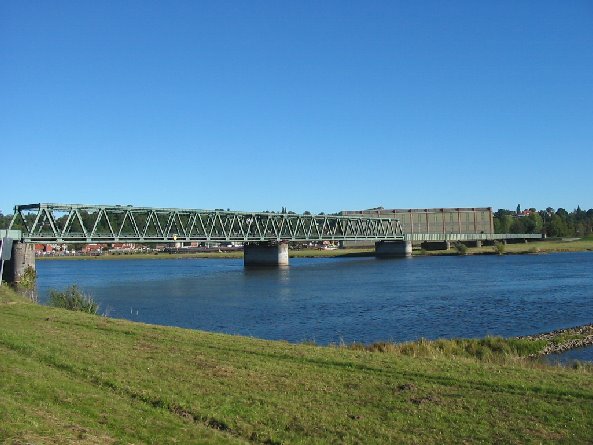
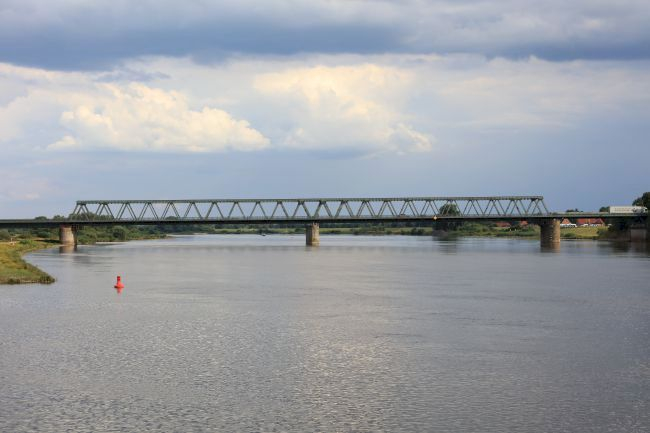
Near this bridge, a major Ford known since the early Middle Ages by the Elbe was approximately between the present-day communities of Artlenburg and Schnakenbek. It was secured by Magnus on the North Shore, after its destruction by the Lauenburg, built in 1182 by Bernard of Saxony, which strategically favourable location at the mouth of the Delvenau in the Elbe.<br><br>The first construction of a pure railway bridge over the Elbe River, with a side walkway, Lübeck–Lüneburg took place in 1878 as part of the railway line and replaced the train ferry Laue Castle Hohnstorf traffic over. The 448-metre building had under other three power outlets with each 100 feet span, three flood openings each 40-meter span and two rotary openings by 14 meters wide.<br>The bridge was laid for two tracks, but was always just a track in operation. The railway bridge was the last hard fought in the second world war. It was in the last days of the war by Wehrmacht units of army group flower occurs under the command of General der Infanterie Günther Blumentritt up to 19 April 1945 for the withdrawal after controlled Schleswig-Holstein and on the same day under the pressure of the advance of the invading English army consisting of the 3rd Battalion of the Royal Tank Regiment and the 4th Battalion of the King's Shropshire light infantry blown up. The swing bridge included in the bridge was destroyed in the first blast. Three are remaining arches made from point of view of the defenders a further second demolition required, which also brought the success hoped for by those responsible. The bitter battle for the beachhead of the allies near Lauenburg dragged on until April 29/30, 1945.<br>Until 1951 it was rebuilt as a combined road and railway bridge.<br>The building combines Lower Saxony and Schleswig-Holstein during the B 209, which in turn flows into Lauenburg on the bridge over the Elbe-Lübeck Canal in the B-5. The bridge is with a length of 517 meters longer than the preceding one. He has eight openings, where the stream channel is spanned with a zweifeldrigen braces truss each 104,61 meters span. The foreland bridges are steel solid wall carrier structures with spans of approximately 53 meters.<br>(Source: Wikipedia)
 No other use permitted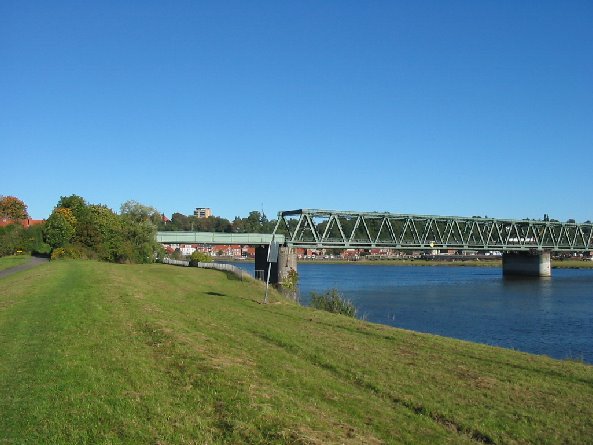
 Use in accordance with the terms and conditions