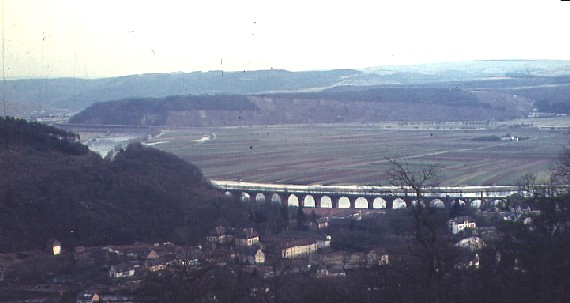
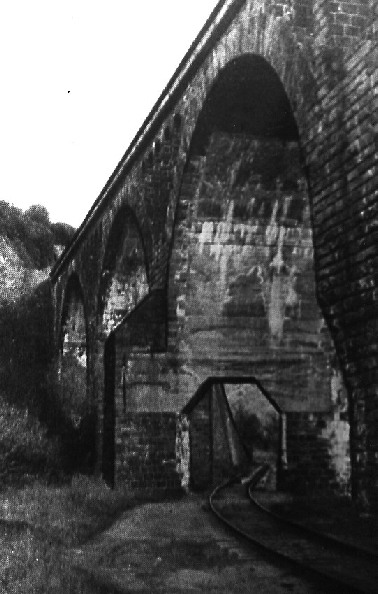
Already before the first world war, plans surfaced to better connect the industry at the Saar and Lorraine on the domestic German routes by a third and fourth track of Trier-Koblenz Moselle railway. During the war, the plans were ready. In Schweich, the planned new route should leave the existing route. And lead to the Rothenberg. A viaduct should bridge the wide opening of the fifth Valley. Construction of the viaduct began in 1917, 1919, the victorious Powers had the setting of work. However, the bridge was completed in the years 1921/22. The construction was at the company J.J. Jager in Merzig. The delivery of the stones carried out the companies "Eifel stone sales" in Trier, J.Schaffner cord and M.Schmitt in Philip home.<br>The order total, the settlement in 1925 (after inflation) on 6 720 000 paper mark amounted to 1 600 000 Gold marks. However, the planned new line was not built due to the traffic requirements changed completely after the war. The viaduct was unused.<br>Once again, its use in the conversation came as planning for a bypass in the course of the B53 began in the 1960s and in the 1970s. The idea to use the bridge as a road carrier, did not materialize however. On the 12.1979, the demolition began with the first two arcs. A striking, architecturally successful bridge work which constituted a dominant element in the landscape on the Mosel arch decades, sank into rubble. His remains disappeared in a famous embankment which today is a part of the ring road of the B53.<br><br>Source: honor anger home
 No other use permitted