BAS 44147
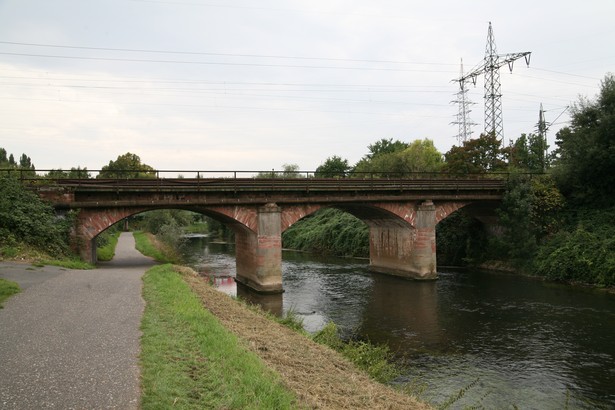
Eisenbahnbrücke Nied
10.09.2008
© Frank Sellke / brueckenweb.de
 Use in accordance with the terms and conditions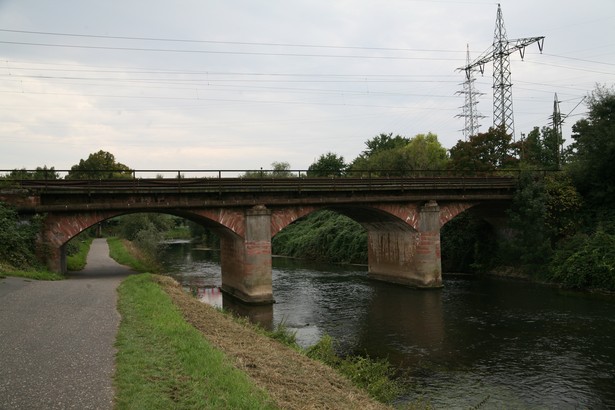
10.09.2008
© Frank Sellke / brueckenweb.de
Use in accordance with the terms and conditions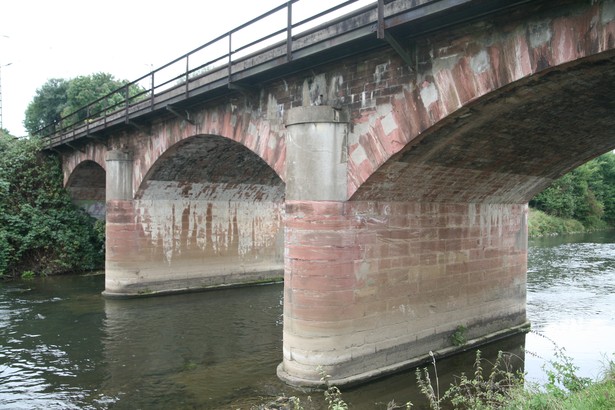
10.09.2008
© Frank Sellke / brueckenweb.de
Use in accordance with the terms and conditionsGermany
Hesse
Frankfurt am Main
Nidda
Railway (Taunusbahn)
arch bridge, arch under the roadway
Sandstone
1838
10.00 m
40.00 m
0.00 m
0.00 m
0.00 m
0.00 m2
in operation
Wikipedia:<br>The railway bridge of Nied in Frankfurt am Main is the second oldest still in operation railway bridge in Germany [1]. The arch bridge was built in 1838 and went into operation in 1839. On it, the Taunus railway crosses the Nidda. The bridge is located between the Frankfurt main train station and station Frankfurt-Höchst in the district Nied.<br><b>Construction</b><bR>The 40 m long arch bridge consists of three arches of 10 m clear span. The curve radii of the soffits are ever 8,40 m vault, both current piers and abutments are made of blocks of red sandstone. Because the Nidda was regulated only in the 20th century and previously regularly led flood, special emphasis was placed on the establishment of the bridge: piers and abutments were anchored by piles in deeper soil layers, to derive the load of the building there.<br><b>History</b><br>Construction and opening<br>The bridge is based on a design of the engineer and railway pioneer Paul Camille von Denis [2], under whose stewardship the Taunus railway 1837 to 1840 was built. The bridge was on 26 September 1839, together with the first section of the line between the free city of Frankfurt and opened high, which was at that time still a separate town in the Duchy of Nassau. Initially the route was only single track operated, expanded until 1869 two tracks, for which the width of the bridge was already chosen for its construction.<br>Later construction measures<br>During the Niddaregulierung in the years from 1928 to 1932, the railway bridge was backed up and restored. in 1931 and 1932 it was stabilized by additional anchor and cracks in the vault filled with sprayed concrete. The basis of the two pillars was reinforced by concrete jacketing and increases the ice deflector until the beginning of the soffit. There was also the bridge pedestrian walkways on the sides. This renovation work cost 4842,80 RM of the Deutsche Reichsbahn.[3]<br>The Niddabrücke adjacent there originally along yet another bridge, which served as a flood bridge. It was 1932 canceled after completion of the regulatory work, closed the gap in the embankment.<br>The Niddabrücke was not damaged in the two world wars.<br>From 27 November 1978 to 28 February 1979, the bridge was renovated again. Were more anchors used and filled with spray mortar cracks and joints. For this construction, the Deutsche Bundesbahn invested more 30.728,80 DM.<br>Present<br>Local train from WiesbadenNoch always leads the Taunus railway across the bridge. She is today predominantly served by the regional transport of three lines in the West of Frankfurt, also that the main-Lahn railway to Limburg an der Lahn. In addition, trains there run the Königsteiner Bahn. The S-Bahn services runs away newer Niddabrücke on the parallel track of the main-Lahn-Bahn and its only a few metres.<br>The high reliability of the stone arched structure is reflected in the long service life of almost 170 years. No change was made to the statics of the building until today. The railway bridge is a monument of culture of the State of Hesse as a result of the Hessian Monument Protection Act. Also, the building belongs to the route of industrial heritage of Rhein-Main.[4]<br><br><b>
Historical ranking</b>
The bridge is considered the oldest still used railway bridge of in Germany [5] in the local history of technology.<br>According to the latest study, which takes into account [1] entered but the railway bridge at Wurzen about the B 6 to the Leipzig-Dresden railway as early as 1838 all the older literature scheduled operation - a year before the Taunus railway - and thus the oldest still busy railway bridge of in Germany.
A map is loading