BAS 49
Golden Gate Bridge
24.07.2012
© Frank Sellke / brueckenweb.de
 Use in accordance with the terms and conditions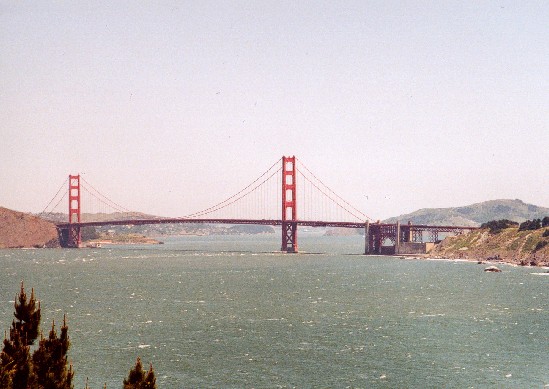
© Frank Sellke / brueckenweb.de
Use in accordance with the terms and conditions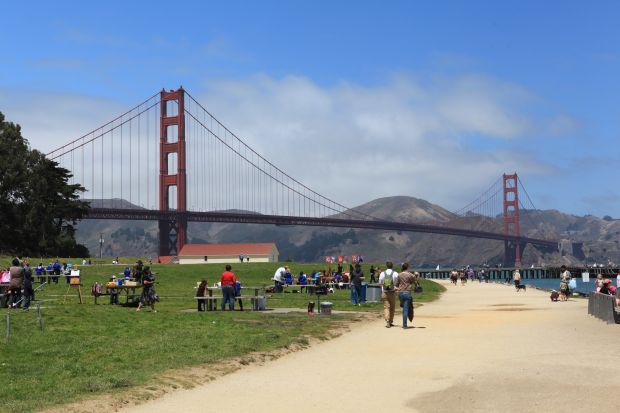
24.07.2012
© Frank Sellke / brueckenweb.de
Use in accordance with the terms and conditionsUSA
California
San Francisco
north of the city
San Francisco Bay
Street
Suspension bridge
Steel
1933 bis 1937
1280.00 m
2737.00 m
25.00 m
0.00 m
227.00 m
0.00 m2
in operation
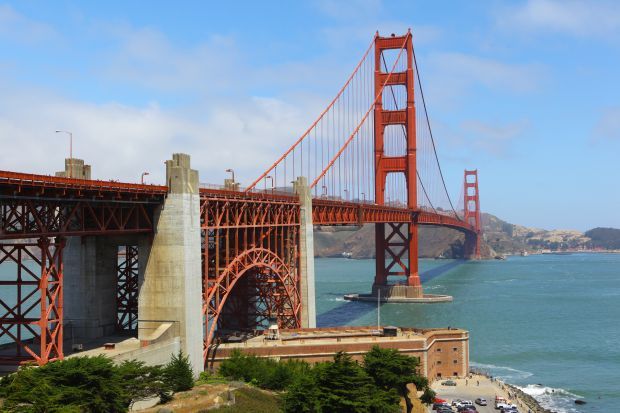
The Golden Gate Bridge is not only an iconic landmark but also an engineering masterpiece that continues to fascinate engineers and bridge enthusiasts. Since its opening on May 27, 1937, to pedestrians and on May 28, 1937, to motorized traffic, it has connected San Francisco with Marin County across the Golden Gate Strait—one of the most challenging construction projects of its time. The strait is known for its strong tidal currents, dense fog banks, and frequent storms, which made its construction a formidable challenge. With a total length of 2,737 meters and a main span of 1,280 meters, the Golden Gate Bridge was the longest suspension bridge in the world upon its completion. The two 227-meter-high pylons support the delicate steel cables, which consist of 80,000 miles of wire – enough to circle the Earth almost four times at the equator. The bridge weighs a total of 887,000 tons, with the main cable alone weighing 24,500 tons. A special technical detail is the bridge's color: "International Orange" was chosen not only for its aesthetic effect but primarily to make the bridge more visible in the frequent fog and cloud formations. Furthermore, a special pigment was used that remains vibrant even in salty sea air. The bridge's construction was a pioneering project. Construction began on the 5th. Construction began in January 1933 and lasted over four years, with official completion on April 19, 1937. The workers not only had to contend with extreme weather conditions but also with the threat of earthquakes – the region lies in an active seismic zone. To ensure stability, the pillars were built on deep concrete foundations that extend up to 34 meters below sea level. Another technical highlight is the earthquake protection system, which was retrofitted in the 1990s. Modern dampers and flexible connections protect the bridge from the effects of earthquakes, which occur regularly in the region. Today, the Golden Gate Bridge is not only a major transportation hub, used by approximately 112,000 vehicles daily, but also a living museum of engineering. Visitors can walk or cycle on the bridge or use the viewpoints to enjoy the breathtaking scenery. With over 10 million tourists per year, it is one of the most visited structures in the world. However, the bridge also has a dark side: it is one of the most notorious suicide locations in the world. To counteract this problem, a suicide prevention net was installed under the bridge in 2014, which has saved numerous lives since its completion in 2021. The Golden Gate Bridge remains a symbol of innovation, resilience, and human engineering – a structure that continues to set standards.
Karte wird geladen …
🗺️ Brückenflächen:|