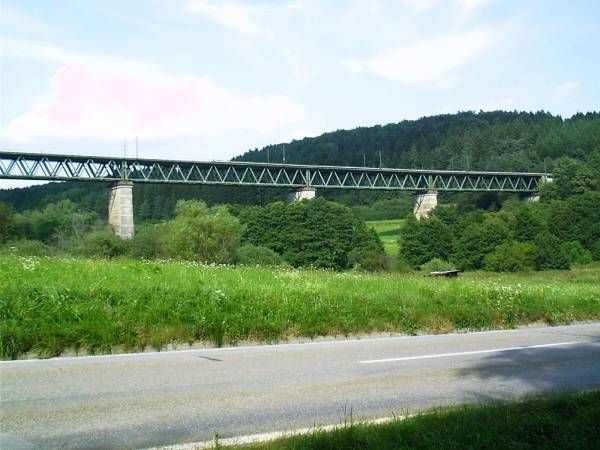
Juli 2008
© Ulrich Winkler
 Use only on request
Keine weiteren Bilder verfügbar
Wikipedia:
History
The Necessity of a Valley Crossing
When the Bavarian Eastern Railway Company began planning a line from Nuremberg – Neumarkt – Regensburg in 1869, the initial plan was to route the line further north from Neumarkt via Velburg to Seubersdorf. Due to significant opposition within the Velburg town council, the project failed, forcing the line to be routed through the considerably more challenging terrain via Deining and Batzhausen. An alternative route was practically impossible, as this was the only way to overcome the ascent into the Franconian Jura. Among other things, the valley of the White Laber River now had to be crossed. To keep the cost of such a valley crossing manageable, a 340-meter-long tunnel near Kleinalfalterbach was initially planned, allowing the railway line to cross the valley at a relatively low elevation. However, test drilling quickly revealed that the sandstone in the Deining region was very brittle and completely unsuitable for tunnel construction with the technology available at the time. It was decided to simply excavate a cutting through the terrain. The excavated material was then immediately used for embankment construction around the bridge.
Complicated construction work
Construction of the bridge began in the autumn of 1870. First, work commenced on building the embankment, which by March 1871 was already 132 meters long and 16 meters high. A straight bridge, supported by two piers, was planned to follow the embankment coming from the east. The resulting spans between the piers were each intended to be 60 meters long. However, heavy, persistent rain caused a major setback. On the night of March 20, 1870, the entire dam began to slide, tearing away the partially constructed end pier of the bridge and rolling into the valley, leaving nothing of the actual dam. The entire structure was then redesigned. The bridge was built higher, and now four piers were to be erected, each with a span of 72 meters. Because the bridge was now extended by 150 meters, the road now curves in the middle of the bridge. Numerous sandstone blocks were quarried in the immediate vicinity. In the valley next to the bridge, a wooden framework was erected to serve as the support structure for the steel truss. Numerous workers were employed on the construction site, not only from southern Germany, but also from Austria and Italy. For these workers, numerous apartments were built around the already completed station building, creating the Deining-Bahnhof settlement. Together with the Neumarkt-Seubersdorf section of the line, the single-track bridge was inaugurated and put into operation on May 15, 1873. The construction costs were reported as 32,077,406 marks. Expansion for double-track operation br />
Addition of the second track
The Bavarian Eastern Railway Company (AG der Bayerischen Ostbahnen) was taken over by the Kingdom of Bavaria in 1875, thereby nationalizing all rail traffic on the line. To increase the line's capacity, planning for double-track expansion soon commenced. Since the bridge had already been designed for a second track from the outset, the planning and cost costs remained low. Later that same year, the necessary load tests were carried out with two steam locomotives, and the second track was also opened to traffic. This allowed for a significant increase in service frequency between Neumarkt and Regensburg. Further Expansion and General Overhaul As locomotives and carriages became increasingly larger and heavier over time, the entire bridge structure was reinforced in 1925. The railway line was electrified as early as 1949. The biggest problem, however, was the curve beginning in the middle of the bridge: trains were only allowed to cross at a speed of 50 km/h, and train encounters on the bridge had to be avoided. The German Federal Railway therefore decided to completely overhaul the bridge. This work was carried out from 1960 to 1969 while the bridge remained in operation. The joints of the masonry piers were grouted with cement mortar, the steel truss was renewed, and a reinforced concrete bearing surface was installed underneath to better distribute the load. A total of 950 tons of steel and more than 38,000 bolts were used. These works increased the bridge's load-bearing capacity. Trains can now easily cross the bridge together; ICE trains cross the Laber Valley here at speeds of up to 120 km/h. ```
A map is loading