BAS 6070
Marie bridge (railway)
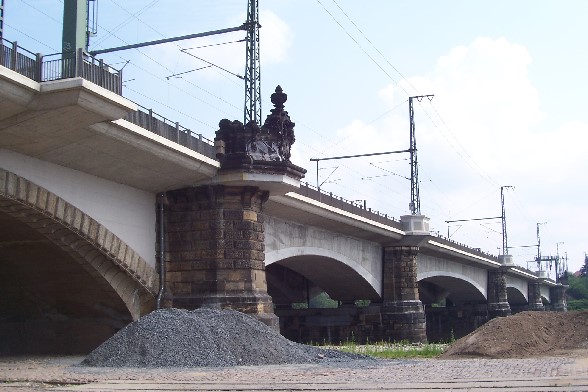
09.07.2006
© Heidi Zengerling
Use of Heidi Zengerling
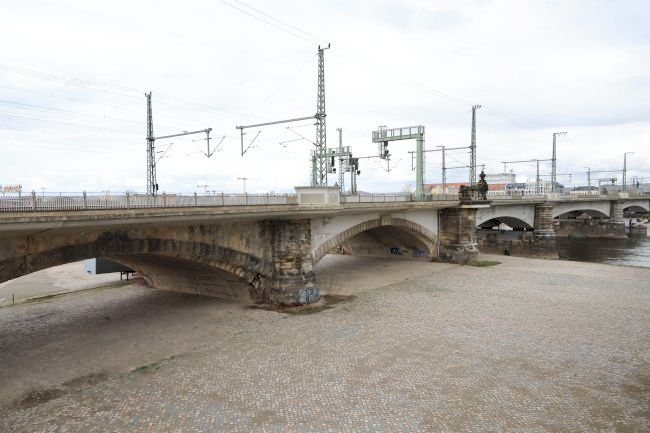
01.04.2023
© www.brueckenweb.de / Frank Sellke
 Use in accordance with the terms and conditions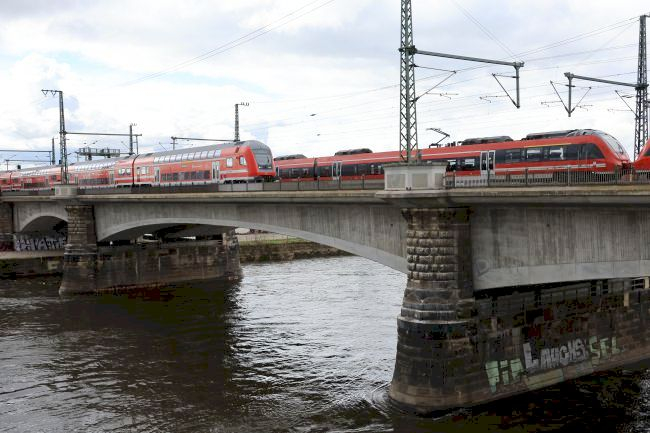
01.04.2023
© www.brueckenweb.de / Frank Sellke
Use in accordance with the terms and conditionsGermany
Saxony
Dresden
In addition to the Marienbrücke
Elbe
Railway
Beam bridge and Cove carrier
Prestressed concrete
1901, 2003-2004 Neubau
67.70 m
490.00 m
0.00 m
0.00 m
0.00 m
0.00 m2
in operation
Wikipedia:<br>The Marienbrücke is a Dresden Elbe bridge. The existing since 1852 building at Elbe kilometre 56.5 was the second fixed crossing of Elbe, a combined road and railway bridge after the Augustus bridge. In 1901, a private, parallel bridge plant was taken for the railway. Since then, the old East, facing the downtown bridge serves road, while the Western bridge with a total of five tracks of the railroad is used. The Marienbrücke is the westernmost of the four inner-city bridges.<br>The railway bridge connects the train station Dresden-Neustadt station. Among the long-haul routes Dresden-Leipzig and Dresden-Berlin run over them.<br><br>Building from 1901<br><br>The first pure railway bridge was built 40 m downstream as part of elevation lowering the railway between the years of 1898 and 1901 after plans by Hans Manfred Krüger. The building was designed for two goods and two passenger train tracks and consisted of a foreland and the power bridge. The foothills of the bridge on the Western Shore is an approximately 203 m long arch bridge with six openings and sparse expanses between 22.0 and 38,12 m. The current bridge was a 258,85 m long steel truss arch bridge with five main trusses and above the roadway. The bridge had five holes with maximum spans 65,75 m three medium-sized boxes, which corresponded to a doubling of the pillar distance compared to the old road bridge. The western end field was the Eastern 24.0 m 37.6 m, far tense.<br><br>Parallel to the construction of a new bridge was torn down the building from 2001.<br><br>Building of 2004<br><br>In the years 2001 to 2004, the hundred-year-old, steel bridge was replaced within the framework of the extension on five tracks by a gevoutete stress concrete hollow box bridge, which was built in the cantilever. The hollow boxes have a construction height of 2.50 m and on the pillars in the field 5.81 m. The new building consists of two separate buildings. The spans of the two current bridges be 36,96 m in the Western final field as well as 67,70 m, 65,80 m and 64,86 m power boxes. The eastern end field consists of a prestressed reinforced concrete slab with 24 m span. The spans are practically unchanged compared to the previous bridge. The speed limit was lifted, opposite the old bridge from 40 to 80 km/h [1].<br><br>In January 2003, the running part with two tracks in operation went. The use of four tracks recorded on April 18, 2004.[1] Five tracks two are used today as planned by the S-Bahn, the three further serve the long-distance, regional and freight transport, where the furthest Pirna this track is still incomplete.<br><br>About 2000 tonnes steel and 45,000 t concrete were spent for the building. The renovation of the entire section between the entrance Dresden-Neustadt and Dresden Hauptbahnhof, including Marie bridge, cost around 100 million euros. The financing was provided by federal, land, railway and EU.[1]<br><br>A six-track bridge was planned in the early stages of planning. A reduction was on the basis of the planned operational programme on five tracks.
Deutsche Bahn
A map is loading