BAS 62586
Trezzo sull'eeepc ' Adda bridge
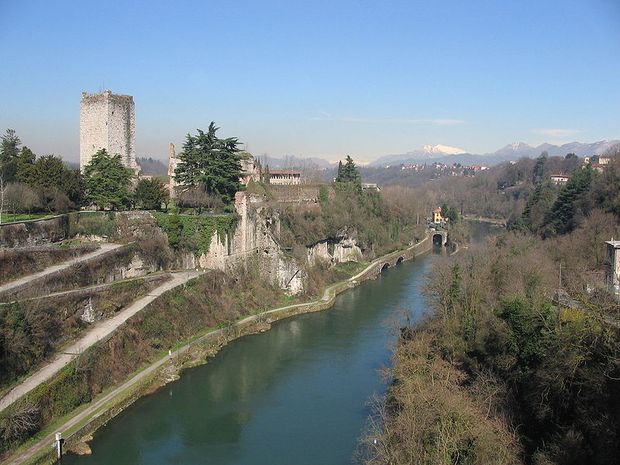
2006
© Wikipedia (Giorces)
 Creative Commons
Keine weiteren Bilder verfügbar
Italy
Lombardy
Trezzo sull'Adda
Adda
Street
arch bridge, arch under the roadway
Stone
1377, 1416 zerstört
72.00 m
0.00 m
0.00 m
0.00 m
0.00 m
0.00 m2
destroyed
The Trezzo Bridge, or Trezzo sull'Adda Bridge, was a medieval bridge in the town of Trezzo sull'Adda in Lombardy, Italy, which existed from 1377 to 1416.
Completed in 1377, this single-arch bridge held the record for the world's largest span (72 m) until the onset of the industrial age.[1][2][3][4] In stone bridge construction, it remained unsurpassed until the beginning of the 20th century.[5]
The Trezzo Bridge was built between 1370 and 1377 by order of Bernabò Visconti, Lord of Milan.[1] It served as access to a Visconti castle across the Adda River and was fortified with towers.[1] As early as 1416, during a siege, it was deliberately brought down by weakening one of the bridge abutments.[1] Its single arch had a span of 72 m,[1][2][3][6] according to other sources it was even 76 m.[7] Thus, the Trezzo Bridge surpassed the second largest pre-industrial bridge arch, the Pont de Vieille-Brioude, by almost 18 m.[1] The rise of the segmental arch was approximately 21 m (a camber of 3.4:1).[1] The arch thickness, measured at the abutments, was only 2.25 m,[1] which corresponded to an advantageous arch thickness-to-span ratio of only 1/32. The width of the sandstone bridge was just under 9 m.[1] Today, the two abutments with their arch springers are still visible on the riverbank.[1]
It was not until 1796, after the introduction of metal construction, that the same span (72 m) was achieved again with the construction of the Wearmouth Bridge in England.[8] In stone arch construction, the dimensions of the Visconti building were not surpassed until the Adolphe Bridge in Luxembourg in 1903.[5]
Karte wird geladen …