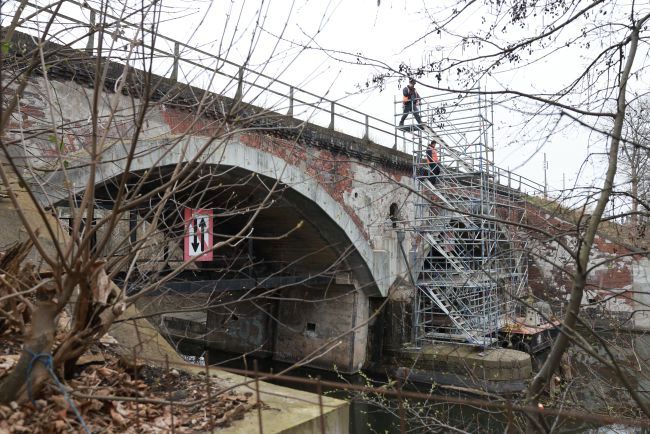
21.03.2026
© www.brueckenweb.de / Frank Sellke
 Use in accordance with the terms and conditions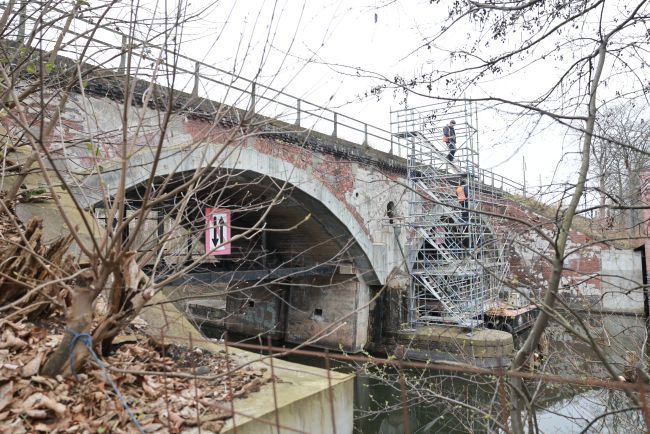
21.03.2026
© www.brueckenweb.de / Frank Sellke
Use in accordance with the terms and conditions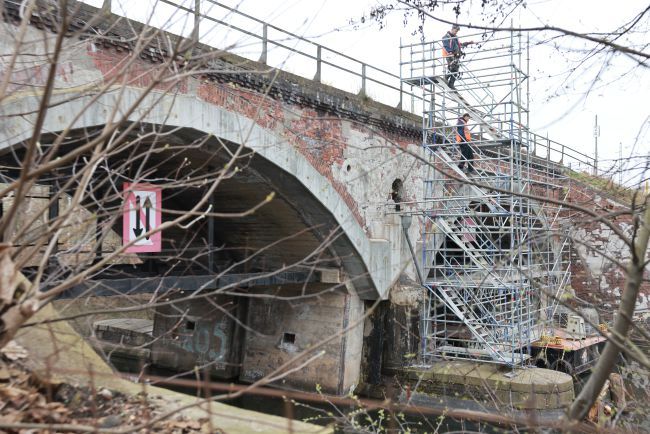
21.03.2026
© www.brueckenweb.de / Frank Sellke
Use in accordance with the terms and conditionsA new structure for the S-Bahn tracks is planned for 2027.
S-Bahn Bridge
The listed railway overpass was built in 1902 as a double-track arched bridge spanning the South Canal with two arches. (See Annex 03.901.1 for the entry in the list of monuments).
The abutments and the central pier of the arch are designed as gravity walls. They consist of unreinforced concrete and are faced with masonry on the visible surfaces. In 1926/27, the arches were reinforced by two reinforced concrete frames each, located in the track axes. Each frame is 4.0 m wide and 45 cm thick in the arch area, and 2.0 m wide and 60 cm thick at the base. The reinforced concrete frames are each founded on eight bored piles, 35 cm in diameter. The settling depth of the bored piles is approximately -7.7 m above sea level (NHN). To absorb horizontal forces, additional steel beams were integrated into the frame structure, connected at the springing points by compression bands. The compression bands are suspended from the steel beams in the reinforced concrete arches. The new reinforced concrete structure is connected to the existing structure by anchors at the level of the arch springings and at the underside of the abutments. In 1954, the canal bed was lowered from +0.3 m above sea level (NHN) to -0.04 m above sea level (NHN) due to a drop in the water level. For this purpose, the concrete linings in the bed area were demolished and reconstructed 66 cm lower. The top of the bed slabs is thus at -2.5 m above sea level (NHN). According to the 2017 sounding plan, the canal bed lies at approximately -2.2 m above sea level (NHN) in the navigation channel. The wing walls of the structure initially run parallel to the canal axis and then, at mid-height, angle to form a retaining wall parallel to the track axis. The abutments and wing walls on the north and south sides are each founded on approximately 190 piles, while the central pier rests on approximately 112 driven timber piles, 30 cm in diameter, at varying angles. The piles are approximately 7.7 m long. The settling depth is approximately -7.7 m above sea level. The abutments and the pier are enclosed by approximately 15 cm thick timber sheet pile walls, which terminate at approximately -3.0 m above sea level. On the east side, a cable duct carries the superstructure. Walkways are located on both sides, within the clearance gauge of the S-Bahn (suburban railway). The lateral boundaries are secured with railings.
Structural Engineering Data:
Design: two arches with central pier
Number of tracks: 2
Number of superstructures: 1
Number of openings: 2
Abutments: gravity abutments
Foundation of abutments/central pier: timber pile foundation
Distance between the front edges of the abutments: 30.40 m (between the reinforced concrete frames)
Clear span of one arch: 13.00 m (between the reinforced concrete frames)
Clear distance between the wing walls: 32.26 m
Superstructure width: 10.20 m
Construction height at crown: 0.77 m + 0.45 m reinforcement = 1.22 m
Construction height at crown: 1.69 m + 0.45 m reinforcement = 2.14 m
Crossing angle with watercourse: approx. 100 gon
Longitudinal gradient: 0.000%
Cross slope / superelevation: 0.00 mm
Track curve radius: R = ∞
Target depth of channel bed: -2.5 m above sea level
Water level: +0.05 m above sea level
Lower edge of construction: +3.16 m NHN (UK of steel structure)
Clearance height (water level +0.05 m NHN): 3.11 m
Track spacing S-Bahn: 4.50 m
Track spacing S-Bahn to main line: 6.35 m
Top of rail: +8.79 m NHN West; +8.77 m NHN East
Load distribution: E / N according to BE 1925 (both E and N are specified in the structure register)
A map is loading