brueckenweb-logo
discover
Icon
bridges
Icon
bridge search
Icon
nearby
Icon
most bridges records
Icon
disasters
Icon
country overview
Icon
collections
Icon
articles
Icon
bridge news
Icon
literature
Icon
store
Icon
Icon
pinboard
Icon
Icon
clubinfo
join in
only for registered club members
administrate
only for registered club members

    1999 - 2026 © Frank Sellke / brueckenweb.de

    Icons by Icons8.com

    Version 5.1.16

    Legal Notice | Privacy Policy | ⚠️ Vertrag widerrufen

    BAS 740
    Europe bridge
    Brückenbild

    01.03.2003

    © Frank Sellke / brueckenweb.de

    gegen Entgeld / for a feeUse in accordance with the terms and conditions
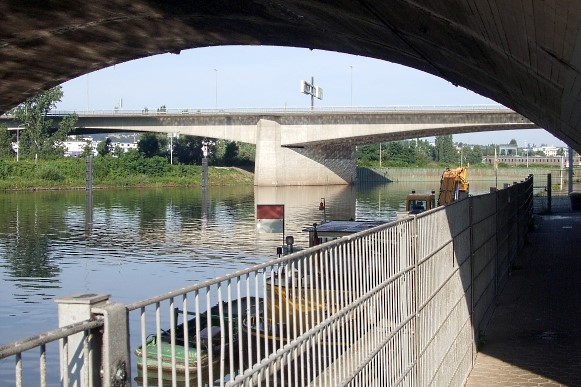
    Bild 1

    14.07.2007

    © Ralf A. Flemming

    Nachfrage / demandUse only on request
    Bild 2

    21.02.2015

    © www.brueckenweb.de / Frank Sellke

    gegen Entgeld / for a feeUse in accordance with the terms and conditions
    To Bridge Images
    Germany
    Rhineland-Palatinate
    Koblenz
    Mosel
    Street
    Cove beam / girder bridge
    Prestressed concrete
    1932-1934, 1952-1954- zweiter gleicher Neubau 70er Jahren
    122.00 m
    500.00 m
    0.00 m

    A map is loading

    Timeline

    Loading timeline...

    Tags

    Loading tags ...

    Editing is available for members (midgr >= 6).

    News

    Lade Nachrichten ... loading news ...

    Links

    Loading links ...

    Literature

    Loading literature ...

    Collectibles

    Loading collectibles ...

    Videos

    Loading videos ...

    Documents

    Loading documents ...

    0.00 m
    0.00 m
    0.00 m2
    in operation
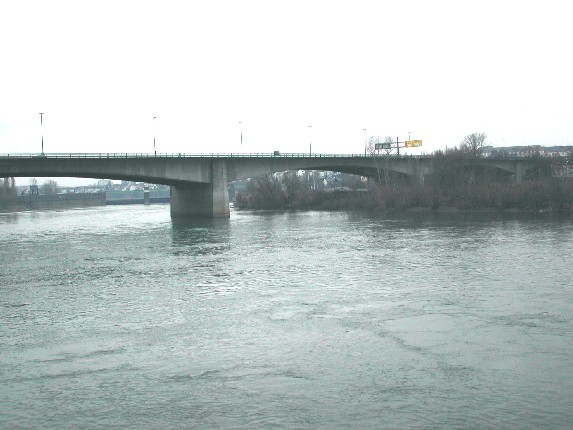
    Once the capacity of the Balduinbrücke ("old bridge") in terms of the constant increase in traffic is no longer sufficient, it was decided at the beginning of the 1930s to the construction of a new, second Mosel bridge that could be opened to traffic on April 22, 1934 – after two years of construction - as "Adolf-Hitler Brücke". This bridge construction was not only a relief of the Balduinbrücke, but which at the same time realized the Pfaffendorf bridge over the Kaiser-Wilhelm-ring city bypass (today: Friedrich-Ebert-ring) and the Empress-Augusta-ring (today: Mosel ring) also a noticeable relief of the city achieved. The first Falckenstein pioneer barracks located on the Moselle's right bank at the time, was replaced by the bridge construction.<br><br>Blown up by German troops in March 1945, the bridge due to the extensive destruction could be passed only 9 years later - 1954 - again, but now the traffic as "New bridge". Through modifications to the bridge such as such as roadway widening, you could meet the ever-increasing volume of traffic again and again in subsequent years. On October 7, 1991, the bridge due to a further Mosel bridge construction (Kurt-Schuhmacher bridge) was renamed in "Bridge of Europe" since now on the one hand the previous designation "New bridge" was inappropriate after the construction of the Kurt-Schuhmacher-bridge and on the other hand, the bridge due to now has been connecting several highways had experienced a supra-regional importance.<br><br>Emanates from a lecture on the "history of civil nature and the Technical University of Munich" by Herbert Kupfer, Munich, on October 24, 2006, the multiple long-span bridges, including the new Moselle bridge 1953-54 (today: Europe bridge) by the civil engineer and doctor honoris causa of the TU Darmstadt & Munich, Ulrich Finsterwalder (1897 1988) was composed of cantilevers which enabled a very simple production in the free stem. Finsterwalders most important invention was the "free stem of Spannbetonbrücken", in economic terms the most successful German patent of the post-war period. He was also for the development of the reinforced concrete monocoque with responsible.
 
 Thus modern and sophisticated bridge building techniques were used in the construction of the bridge of Europe.