brueckenweb-logo
discover
Icon
bridges
Icon
bridge search
Icon
nearby
Icon
most bridges records
Icon
disasters
Icon
country overview
Icon
collections
Icon
articles
Icon
bridge news
Icon
literature
Icon
store
Icon
Icon
pinboard
Icon
Icon
clubinfo
join in
only for registered club members
administrate
only for registered club members

    1999 - 2026 © Frank Sellke / brueckenweb.de

    Icons by Icons8.com

    Version 5.1.16

    Legal Notice | Privacy Policy | ⚠️ Vertrag widerrufen

    BAS 7417
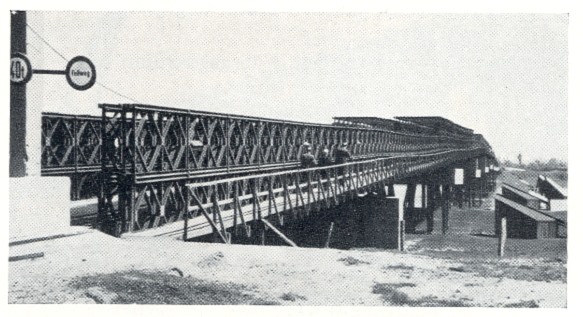
    Montgomery bridge
    Brückenbild

    © Denkschrift zur Übergabe der wiederhergestellten Strassenbrücke über den Rhein bei Wesel (1953)

    verboten / prohibitedNo other use permitted
    Querschnitt der Brücke

    Querschnitt der Brücke

    © Denkschrift zur Übergabe der wiederhergestellten Strassenbrücke über den Rhein bei Wesel (1953)

    verboten / prohibitedNo other use permitted
    System der Brücke

    System der Brücke

    © Denkschrift zur Übergabe der wiederhergestellten Strassenbrücke über den Rhein bei Wesel (1953)

    verboten / prohibitedNo other use permitted
    To Bridge Images
    Germany
    North Rhine-Westphalia
    Wesel
    upstream in addition to today's bridge over the Rhine
    Rhine
    Street
    Truss bridge
    Steel
    1946, 1953 demontiert
    73.15 m
    619.82 m
    13.80 m

    A map is loading

    Timeline

    Loading timeline...

    Tags

    Loading tags ...

    Editing is available for members (midgr >= 6).

    News

    Lade Nachrichten ... loading news ...

    Links

    Loading links ...

    Literature

    Loading literature ...

    Collectibles

    Loading collectibles ...

    Videos

    Loading videos ...

    Documents

    Loading documents ...

    0.00 m
    0.00 m
    0.00 m2
    destroyed
    A short time after commissioning of the temporary bridge from the April/May 1945 it was clear that capacity would not be enough. So a new provisional bridge was built ready in 1946, the Montgomery bridge.<br>The Bailey truss consisted of the widespread system of quick construction. The creation was realized by the existing temporary bridge with Franki piles. On the 24.08.1945, the Frankipfahl construction company from Düsseldorf received an order for the establishment.<br>Since the American temporary bridge was slightly lower than the Bailey bridge be built the undercurrent, the American bridge could first as piling stage and later as formwork for the pillar heads, as a working platform for the concrete work and be used as scaffolding for the Bailey bridge.<br>The construction of the buildings was carried out following operations:<br>1 production of medium-sized parent building in the axis of the lower-power bridge over the pillars of III-V, initially only one-story.<br>2. Longitudinal displacement of this excessive construction on the means of opening up the pillar of VI. This measure was necessary, as was between piers V and VI the old American temporary bridge for shipping reasons canceled already to a large extent and thus eliminates the platform for the Assembly of the steel superstructure.<br>3. Construction of other buildings in the axis of the lower power bridge, two-storied.<br>4. Cross-connection of individual superstructures in the axis of the upper stream bridge to 7.32 m. Here the cantilevered racks in the final location moved first and then the mounted racks on special auxiliary consoles, which were attached to the ends of the arms.<br>5. Increase the upper power-superstructures<br>6 Construction of buildings of lower power bridge in the same sequence.<br><br>Only English pioneer units carried out the installation of steel superstructures.<br>At both ends, the bridge has received ever a portal as a conclusion. The portals have been named of the English Mr leader, significantly involved in the enforcement of the Rhine passage field marshal Montgomery.<br>The bridge was completed in only 5 months. The bridge was opened on the 5th, 1946.<br><br>In the first winter (1946/1947) the bridge was at highest risk. Strong drift ice threatened the bridge. The ice cream took to the ice breakers before the bridge piers and formed a nearly closed ice. The bridge could survive the winter ice blasting conducted only through the use of icebreaker ships and English pioneers.<br>Through the narrow passage of the ship there was numerous maritime accidents, as a Dutch tug named 'Modes', which immediately sank on an ice Crusher before a pillar of power and a ship crane had to be recovered z.B.<br>Cars and trucks dufen only with 25 km/h drive over the bridge, still got the bridge violent fluctuation, so that local residents spoke soon from the 'lively rubber bridge'.<bR>After the construction of the new Rhine bridge (BAS 140) 1953 the Montgomery bridge was canceled.