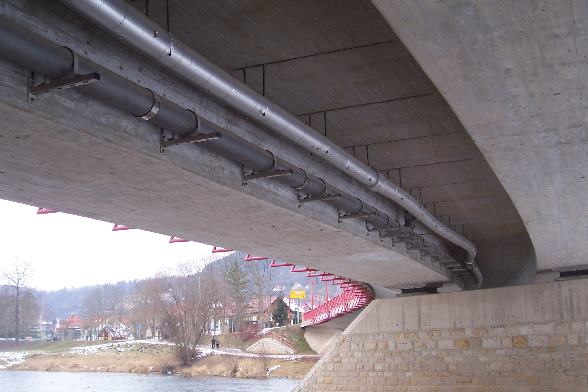
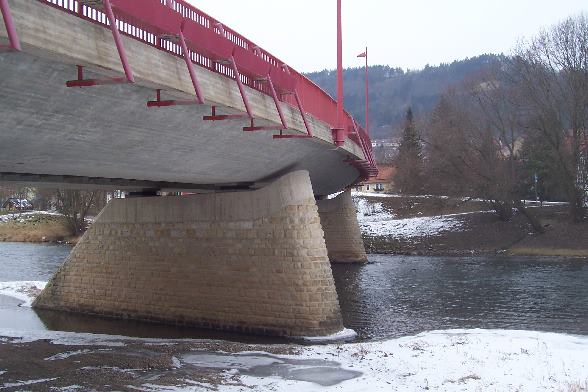
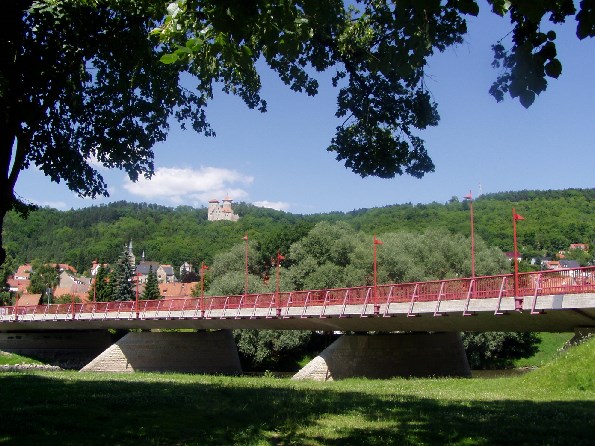
Client: Federal Republic of Germany, Federal Ministry of transport<br>Sponsor: Free State of Thuringia, Thüringer Landesamt für road construction<br>Office design: Cancer and pine consulting Eng. for das Bauwesen GmbH<br>Structural Engineering: Eng.-Office adhesive GmbH<br>Construction: M.Otto bridge GmbH<br>Construction supervision: Ing.-Community Setzpfandt FmbH &amp; Co.KG<br><br>Superstructure: prestressed concrete<br>Pier and abutment: reinforced concrete<br><br>Field widths: 27,369 m + 33,292 m + 22,346 m<br>Superstructure width between 12.50 and 15.75 m<br><br>Information by Heidi Zahir:<br>The existing bridges over the Werra and flood ditch in the border area of the former GDR no longer meet today's requirements in terms of stability and safety. The carrying capacity of only 12 tonnes represented a significant obstacle for the transport and the wirtschaftioche development in the Wartburgkreis district of Northern.<br>In addition to the usual requirements for sustainability, durability and safety, it had to be also target of building design to undergo the neighbouring bridges with its exposed situation in the town of Treffurt of a single but challenging design. The bridges should fit not only harmoniously in this wonderful part of the Werra Valley, but by an indiviiduelle and special design emphasise the importance of the new traffic route with its Werra crossing.<br>The superstructure is reminiscent of a ship. The entire bridge is located in the circular arc with a radius of 170 m and it crosses the Werra at an angle of approx. 60 gon. The superstructure cross-sections with a width of 12 to 15 meters (walkway upper power unterstrom 2 m, shared pedestrian and cycle route 3 m roadway width 7-10 m) should not only in its shape, follow the ideas of the design concept of the bridge, but at the same time offer the opportunity to covert transfer of numerous lines of supply einslchließlich the cables to the Bridge drainage. So, a plate thrown in the Mittelberiech was chosen similar to a Board cross section bars, offers sufficient space for the arrangement of media and conduit between the piers. The out rounded bottom of the superstructure top power could symbolize the bug of Schciffes, the straight and steady transition of the lower edge of plate at the cornice shows the rear. The sophisticated design of the moldings and railings in conjunction with the lighting poles complete this impression. Also for the design of the units is the design principles mainly in addition to the static structural and functional requirements. The Western wing of the two abutments (unterstrom) wuirden with the same aim of outward to 75 degree inclined. The design of the pillar corresponds to the design of the superstructure and continues this down harmoniously. So are the pillars slices of the width of the superstructure itself on networked. The pillar is designed as a rectangular plate with attached, different sized boar. The thickness of the pillars with stone masonry-clad and rounded on the sides is 1.5 m.<br>Because the concrete visible surfaces of the deluded view surfaces to subordinate themselves, a rough saw, 10 cm wide Board formwork with tongue and Groove was chosen. The slopes of wing walls and pillars are co-ordinated. The establishment of the abutment could be made einheietlich as a flat Foundation on the relatively flat standing sandstone. The arrangement of lamps is not only the proper illumination of the bridge, at the same time, she was a design component. In color and material adapted to the railing with bias-related posts from the post and its flower boxes they complete the picture. As optical counterpart an intense carmine red was elected the subtle colour of sandstone facing on the bases as the color for balustrades, flower boxes and light poles. The Werra is part of the Federal waterway network in the building area, special features (such as radar reflectors, etc.) were however not required.<br>The abutment and Pier were in traditional construction in situ concrete, but hächste the execution of the formwork requirements provided with the implementation of the designed geometry of abutment and pier with its curved and partially inclined surfaces. Moreover, that the natural stone veneer-not fully surface, but just had to run to the bottom of the support base. The production of closed piling boxes provided for all substructures, which ausgestteift and after the foundations to be had strengthened, required a drilling before pile-driving the profiles locally. The construction performed in situ concrete B-45 over the Werra bridge was made on traditional Falsework. Due to the planned Cabinet geometry formwork surfaces however, came into the superstructure, were just over the surface or space no longer to describe mathematical equations or geometric shapes. The implementation of the design of the superstructure on the ground could are made possible only through the application of spatial CAD programs in the creation of sound plans and a high Championship during the forming operations. As a bright, uniform sight of the superstructure as a contrast to the stone facing of the substructure and the Red railings, flower boxes and lighting posts was an essential part of the design concept, attention had to be formwork pretreatment, concrete mix, concrete technology and after-treatment geschnkt but also the installation of 10 cm wide, planed Board formwork. The caps and cornices were allowed to run only after verification of the situation just as well as höhengerechtenHerstellung of the superstructure.<br>By moving the location of the new Werra bridge, the traffic could be maintained during the construction of the old bridge.<br>After the release of the section of B 250 in the field of new Werra bridge and the small flood bridge, which was also run as three-box bridge, however in reinforced concrete with the same creative forms and details, the two old bridges could be canceled. On June 27, 1998, the new Werra bridge was inaugurated with a town festival.<br>By the Bundesmin. for traffic wurdein of the brochure "Bridges and tunnels of the 1998 Federal Highway" noted: "the new Werra bridge in Treffurt succeeded, harmoniously combine a lovely river landscape and an old picture of the city with a modern, aesthetically successful bridge.
 No other use permitted