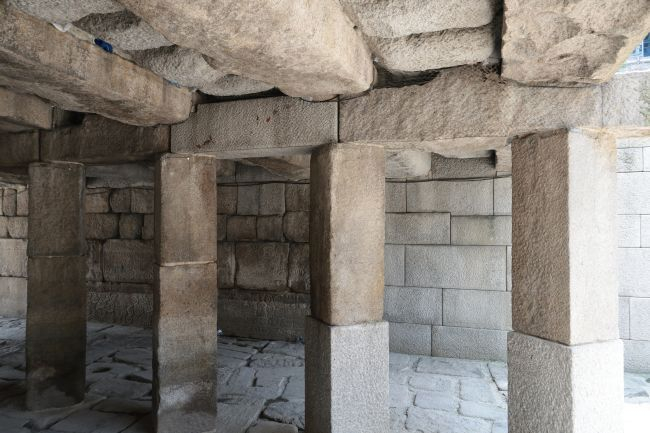
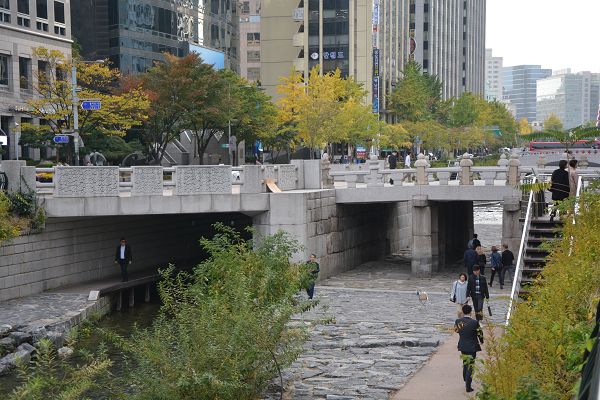
The Gwangtonggyo Bridge was one of the most important and busiest bridges in Seoul during the Joseon Dynasty, when markets could be found on both sides of the river. Originally built with wood and earth, it was destroyed by massive floods.
Construction began during the Joseon Dynasty in 1410 under King Taejong, who reigned from 1400 to 1418. Taejong used the stones from Queen Sindeok's tomb as a symbol of his ruthlessness, power, and his involvement in state and royal affairs. The stonemasons who worked on it were some of the best of the time. The bridge was also known as Daegwangtonggyo.
In the past, the bridge connected Jukjo Street with Namdaemun Gate. Around the same time, two other bridges were built nearby: Samilgyo and Saebyeokdari. Royal parades crossed the bridge, along with foreign visitors who were in Seoul to visit the palaces.
A public festival was held here on the first full moon of the year. People from all social classes came here to play games and fly kites. It was also believed that those who crossed the bridge would have better health and be protected from illness. People would also eat all kinds of nuts to drive away evil spirits, as it was thought that the sound of a nut would draw these spirits away.
From 1958 to 1975, the Cheonggyecheon Stream area was developed into a 5.7-kilometer-high highway.
The bridge had been buried for over 100 years. Restoration work, along with the reopening of the stream, began in 2003 and was completed in 2006. During this work, the bridge was extended with concrete. Some of the stones that can be seen today are original.
(Google Translate)
The Cheonggyecheon is an approximately 8-kilometer-long artificial river in downtown Seoul. The river, flowing from west to east, empties into the Jungnangcheon River and eventually into the Han River, which ultimately flows into the Yellow Sea. During the presidency of Park Chung-hee, the Cheonggyecheon was covered with concrete; an elevated highway was built here in 1968. Today, the area is a recreational area with a river and waterfront promenades.
...
 Use only on request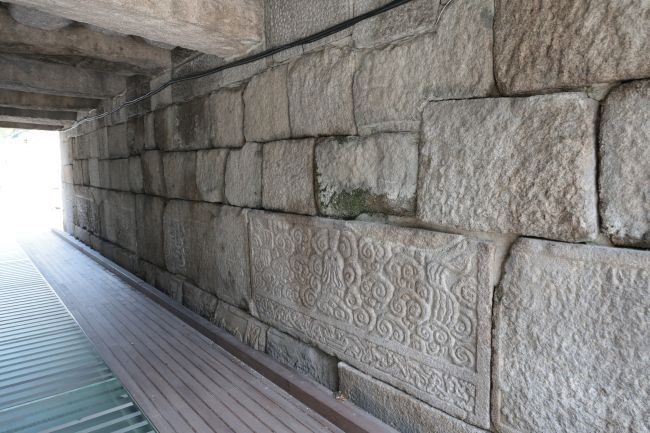
 Use in accordance with the terms and conditions