BAS 8401
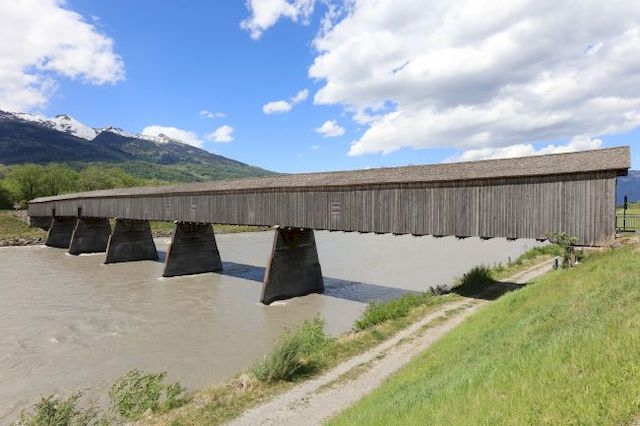
Seveler Rhine bridge
30.04.2018
© www.brueckenweb.de / Frank Sellke
 Use in accordance with the terms and conditions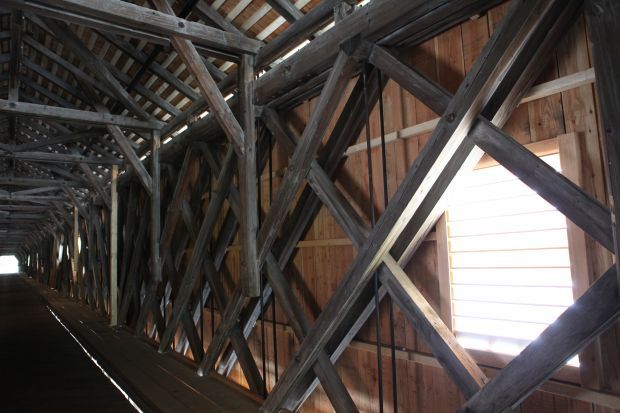
03.07.2011
© Frank Sellke / brueckenweb.de
Use in accordance with the terms and conditions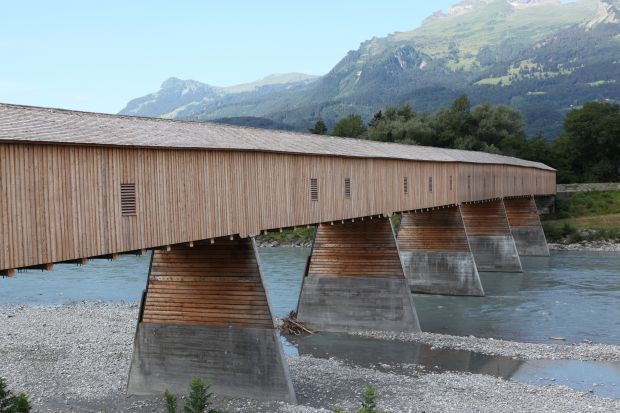
03.07.2011
© Frank Sellke / brueckenweb.de
Use in accordance with the terms and conditionsSwitzerland / Lichtenstein
St. Gallen
Sevelen / Vaduz
Rhine
Pedestrian
covered wooden bridge
Wood
0.00 m
135.00 m
0.00 m
0.00 m
0.00 m
0.00 m2
in operation
Wikipedia:<bR><bR>Starting position<bR><bR>In the 19th century, the Rhine on the border of Liechtenstein and of Switzerland was not regulated until a few exceptions and could therefore largely free flow. Persons and goods was therefore by Rhine ferries which were entertained between Liechtenstein and the Switzerland at the beginning of the 19th century in five places.[1] The beginning of the Rhine correction mid of 19th century laid the foundation stone for the bridge: the first bridge of the Rhine between Liechtenstein and the Switzerland created 1867/1868 between Bendern and the Hague, as well as between Schaan and Buchs SG.[1]<bR><bR>Previous construction<bR><bR>The first Rhine bridge between Vaduz and Sevelen was built in the years 1870-1871. The costs thereby contributed to two-thirds the commune of Vaduz and a third of the commune of Sevelen, where also the country Liechtenstein participated at the Vaduz cost share. The former building had a length of 135 meters and a width of about 5 meters. Due to the increase of the Rhine dams, the bridge had to be raised twice in 1874 / 1875 and 1886. Finally, the poor structural condition necessitated a new building.[2]<bR><bR>New building<bR><bR>Finally, in the years of 1900/1901, the bridge was built new on the pillars of the previous bridge. The bridge, whose payload was 3.5 tonnes, at the time of opening was Rhine crossing both the motorized and non-motorized traffic. After a flood and a dam collapse in the year 1927 in Schaan, the damaged bridge was repaired and once again raised. The payload was increased to 6 tonnes in the course of this work.[3] In 1975, a new, concrete Rhine bridge was created approximately 200 m south of the old Rhine bridge so that the old Rhine bridge since then only for non-motorised transport is accessible.[2] After renovation and decoration are in the 1950s and the last major renovation took place in the years 2009/2010 the 1980s.[4]<bR><bR>Construction<bR><bR>The bridge was built after the so-called Howe'schen system. While combining diagonal pressure limbs from wood with vertical tension members made of metal. The structure could be harnessed by tightening the screws of the metal tension members, and also later requirements could be readjusted. Six fields, of which the inner about 20.5 meters long are four result of the five pillars. The outer two boxes, which connect the bridge to the Rhine dams, are respectively 26.8 meters long.[5]
Karte wird geladen …