Wikipedia:
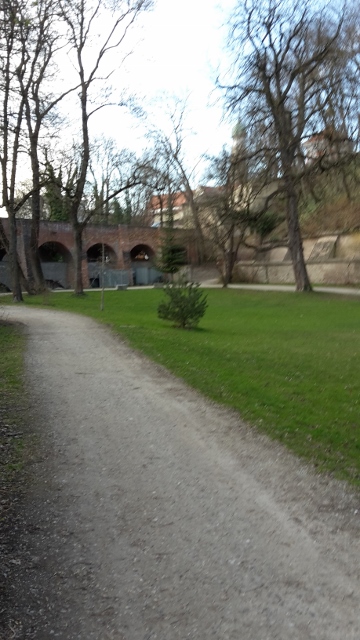
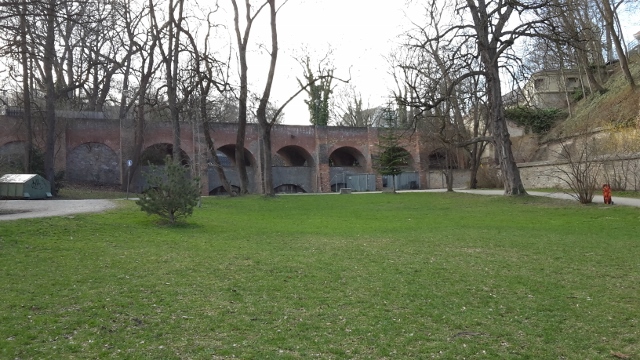
The aqueduct at the Red Gate in Augsburg is a historic structure and a monument to Augsburg's historic water management system. It has a dual function: On the lower level, between the arches, it served as an aqueduct for transporting river and drinking water across the city moat of the fortifications and into the city. On the upper level, it served as a viaduct bridge for people, animals, and carts across the city moat to the Red Gate. It is the only remaining bridge over the former city moat that once encircled the city. Today, the aqueduct is a listed building as part of the ensemble at the Red Gate.
The original wooden aqueduct was replaced in 1777 by a brick structure built by the Augsburg architect Johann Christian Singer on the same site. The solid structure has six arches and two levels. The water channel between the arches originally had a wooden partition to separate the utility water of the Lochbach, flowing on the left, from the drinking water of the Brunnenbach, flowing on the right. The Brunnenbach's water was channeled through openings in the bastion near the Red Gate into the courtyard of the waterworks at the Red Gate. There, it was pumped up into the water towers to supply the city's public fountains and private households with the necessary pressure. Today, the two streams are combined, and all the water of the Lochbach flows past the Upper Well Master's House on the left. From this point, its channel is called the Vorderer Lech (Front Lech).
Since 1929, the aqueduct has served as part of the scenery for the open-air theater at the Red Gate. The bridge, as part of the open-air theater area, is no longer accessible to the public, and the Red Gate no longer functions as a gateway; access to the old town now leads past the open-air theater on the left and then past the gate on the left.
In 2004 and 2005, the aqueduct and bridge structure were extensively renovated by the city of Augsburg.
 Use only on request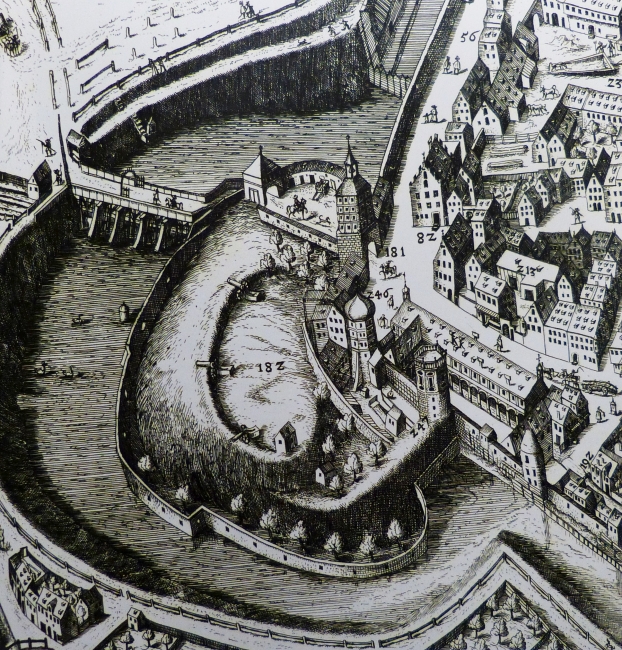
 Creative Commons