BAS 95791
Leinakanal Aqueduct
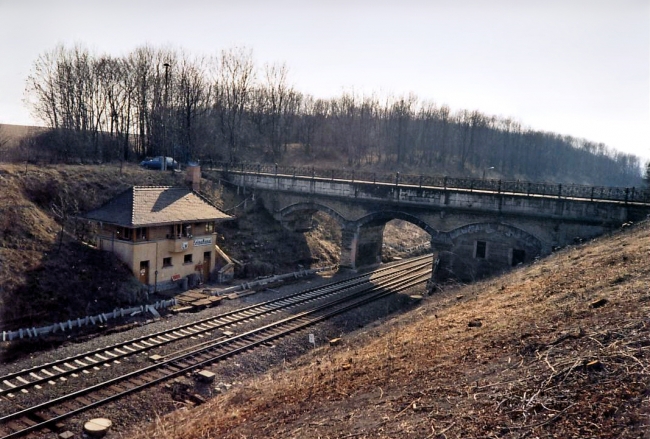
Der Aquädukt vor der Verlegung der Eisenbahn
14.03.1993
© Harry Vorreiter (Wikiepedia)
 Creative Commons
Keine weiteren Bilder verfügbar
Germany
Thuringia
Gotha
former railway
Drinking water canal
Arch bridge, arch under the roadway
brick
1847
0.00 m
0.00 m
0.00 m
0.00 m
0.00 m
0.00 m2
in operation
Following the conclusion of a state treaty on December 20, 1841, between the Kingdom of Prussia, the Grand Duchy of Saxe-Weimar-Eisenach, and the Duchy of Saxe-Coburg and Gotha, construction of the Thuringian Railway began. The planned route was also intended to cross the Leina Canal. To avoid blocking it, which would have meant its demise, an aqueduct was built over the railway line near Sundhausen. With the approval of the overall Thuringian Railway project in October 1844, permission was also granted for the construction of a canal bridge to carry the Leina Canal at kilometer 141.923. This is, incidentally, the highest point of the railway on this section. Earthworks began in 1845. Immediately after the cutting into the Memelberg hill from the direction of Gotha was completed, construction of the canal bridge could begin in the spring of 1847. The original course of the canal bed was approximately 200 meters away from the current crossing at an acute angle towards Fröttstädt. This alteration to the canal's course represents one of the few deviations from its original state.
A three-part arched bridge was constructed, upon which a concrete basin for the canal's water was placed. The primary building materials were limestone from a quarry near Teutleben, and Seeberg sandstone was used for more delicate components. Originally, single-track operation was planned. A signal box was built next to the bridge, and in 1910, the Leinacanal station (as it was spelled at the time) was added.
Other traditional functions of the Leina Canal gradually declined in importance around the turn of the century. While the water flow was maintained by the construction of the aqueduct, the mills lost their significance. In 1895, the Bergmühle mill in Gotha was demolished, and water features, known as the Gotha Waterworks, were erected on the same site. These water features were powered for many years by a pump, which is still functional today. This pump was driven by the Leina Canal itself and is still activated for special festivals.
Even at the beginning of the 20th century, the space under the central arch of the aqueduct, which had a clear width of 7.54 m, was too narrow. With the expansion of the signal box into a passing loop in 1912, the central support piers were rebuilt slightly narrower to make room for the two tracks. (Wikipedia)
A map is loading