BAS 98304
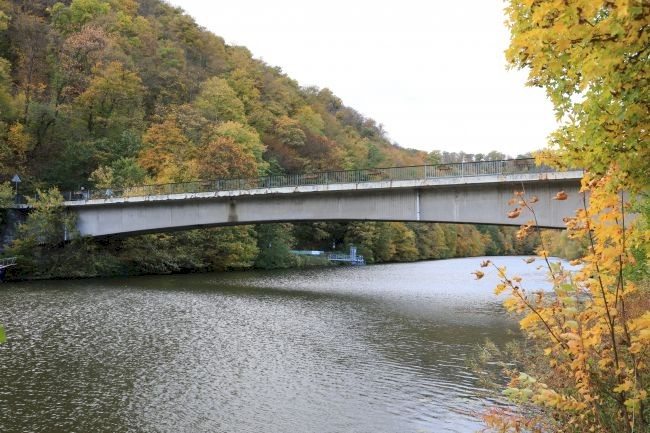
Lahn Bridge Balduinstein
24.10.2020
© www.brueckenweb.de / Frank Sellke
 Use in accordance with the terms and conditions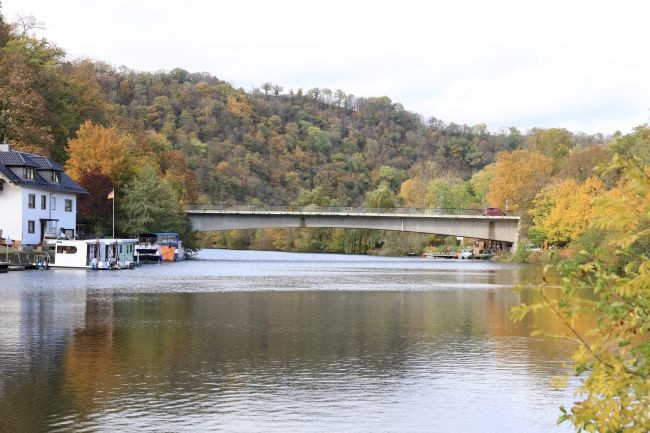
24.10.2020
© www.brueckenweb.de / Frank Sellke
Use in accordance with the terms and conditions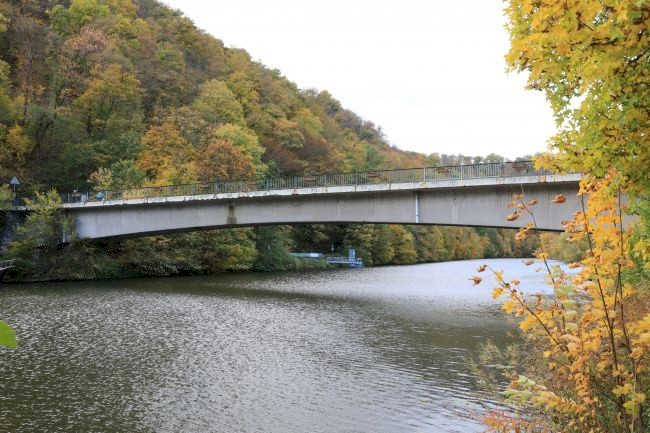
24.10.2020
© www.brueckenweb.de / Frank Sellke
Use in accordance with the terms and conditionsGermany
Rhineland-Palatinate
Balduinstein
Lahn
Street
Beam bridge
prestressed concrete
1950-1951
62.00 m
0.00 m
0.00 m
9.00 m
0.00 m
0.00 m2
in operation
The bridge was the first prestressed concrete bridge built using the cantilever method.
Description
The bridge is a 62-meter-long, curved, two-girder slab bridge made of prestressed concrete. It was designed by Ulrich Finsterwalder and built by Dyckerhoff & Widmann using their Dywidag system with counterweights behind the abutments.
It was constructed using the cantilever method from both sides in 3-meter concreting sections and anchored with prestressing rods developed by Finsterwalder, which had a special thread for anchoring and could be extended as needed using couplings.[1]
The bridge has since become deteriorated due to age. The permissible total weight for road traffic has been limited to 12 tons. Investigations revealed that the bridge could not be repaired, so a new bridge was to be built a few meters upstream and the old one subsequently demolished.[2][3][4]
History
The bridge replaced an iron truss arch bridge from 1903, which was destroyed by the Wehrmacht in March 1945, shortly before the end of the Second World War, to delay the advance of American troops. Martin Heil from Balduinstein operated a ferry service until the new bridge was opened on April 25, 1951. The statue "The Last Ferryman of Balduinstein," erected on the bridge in 1953, commemorates this.[5]
Planner: Ulrich Finsterwald
Description
The bridge is a 62-meter-long, curved, two-girder slab bridge made of prestressed concrete. It was designed by Ulrich Finsterwalder and built by Dyckerhoff & Widmann using their Dywidag system with counterweights behind the abutments.
It was constructed using the cantilever method from both sides in 3-meter concreting sections and anchored with prestressing rods developed by Finsterwalder, which had a special thread for anchoring and could be extended as needed using couplings.[1]
The bridge has since become deteriorated due to age. The permissible total weight for road traffic has been limited to 12 tons. Investigations revealed that the bridge could not be repaired, so a new bridge was to be built a few meters upstream and the old one subsequently demolished.[2][3][4]
History
The bridge replaced an iron truss arch bridge from 1903, which was destroyed by the Wehrmacht in March 1945, shortly before the end of the Second World War, to delay the advance of American troops. Martin Heil from Balduinstein operated a ferry service until the new bridge was opened on April 25, 1951. The statue "The Last Ferryman of Balduinstein," erected on the bridge in 1953, commemorates this.[5]
Planner: Ulrich Finsterwald
A map is loading